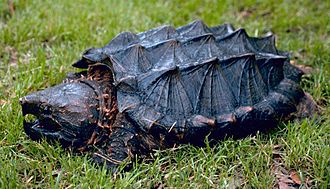
A heavyweight prehistoric-looking turtle with a powerful beak and a 50-pound max weight. Long-lived (up to 100 years), often-misunderstood, and a critical scavenger and predator in freshwater ecosystems.
§ Quick facts
§ Encyclopedia
The common snapping turtle is a species of large freshwater turtle in the family Chelydridae. Its natural range extends from southeastern Canada, southwest to the edge of the Rocky Mountains, as far east as Nova Scotia and Florida. The present-day Chelydra serpentina population in the Middle Rio Grande suggests that the common snapping turtle has been present in this drainage since at least the seventeenth century and is likely native. The three species of Chelydra and the larger alligator snapping turtles are the only extant chelydrids, a family now restricted to the Americas. The common snapping turtle, as its name implies, is the most widespread.
Source: Wikipedia — Common snapping turtle Licensed under CC BY-SA 4.0
§ Identification
Field marks. Massive turtle with serrated rear edge of shell; long muscular tail with sawtooth dorsal ridge; large head with powerful hooked beak; small plastron (cannot enclose limbs).
Similar species. Alligator Snapping Turtle (much larger, beak more hooked, range in southeast). Mud turtles (much smaller, completely different shape).
Voice. Hisses defensively.
§ Diet & behavior
Diet. Omnivorous: fish, amphibians, smaller turtles, waterfowl, mammals, carrion, aquatic plants, fruits.
Behavior. Largely aquatic — lives in nearly any permanent water body. Despite fearsome reputation, snapping turtles are docile in water; only dangerous on land where they cannot retreat into their (proportionally small) shell. Females migrate up to 1.5 km from water to nest, often crossing roads. Lays 25–50 eggs per clutch; hatchlings vulnerable to nearly every predator. State reptile of New York.
§ Range
Eastern and central US; expanding north
§ Habitat
Almost any permanent body of fresh water with muddy bottom and vegetation
§ Threats
Persecution, vehicle strikes during nesting season, illegal harvest for soup.
§ Conservation status
According to the IUCN Red List, the common snapping turtle is currently classified as Least Concern.
§ What helps
Don't kill snappers — they keep aquatic ecosystems balanced. Help them cross roads safely (lift by the back of the shell, not the tail).
§ Further reading
- Wikipedia — Common snapping turtle
- www.nwf.org — authoritative profile of Chelydra serpentina
- IUCN Red List · taxon 163424
- iNaturalist · taxon 39705
- GBIF occurrence records
- Encyclopedia of Life — Chelydra serpentina
§ Sources cited
- Turtle Conservation Coalition
- Davidson College Herpetology Lab
- New York State Department of Environmental Conservation
- IUCN Red List 2011