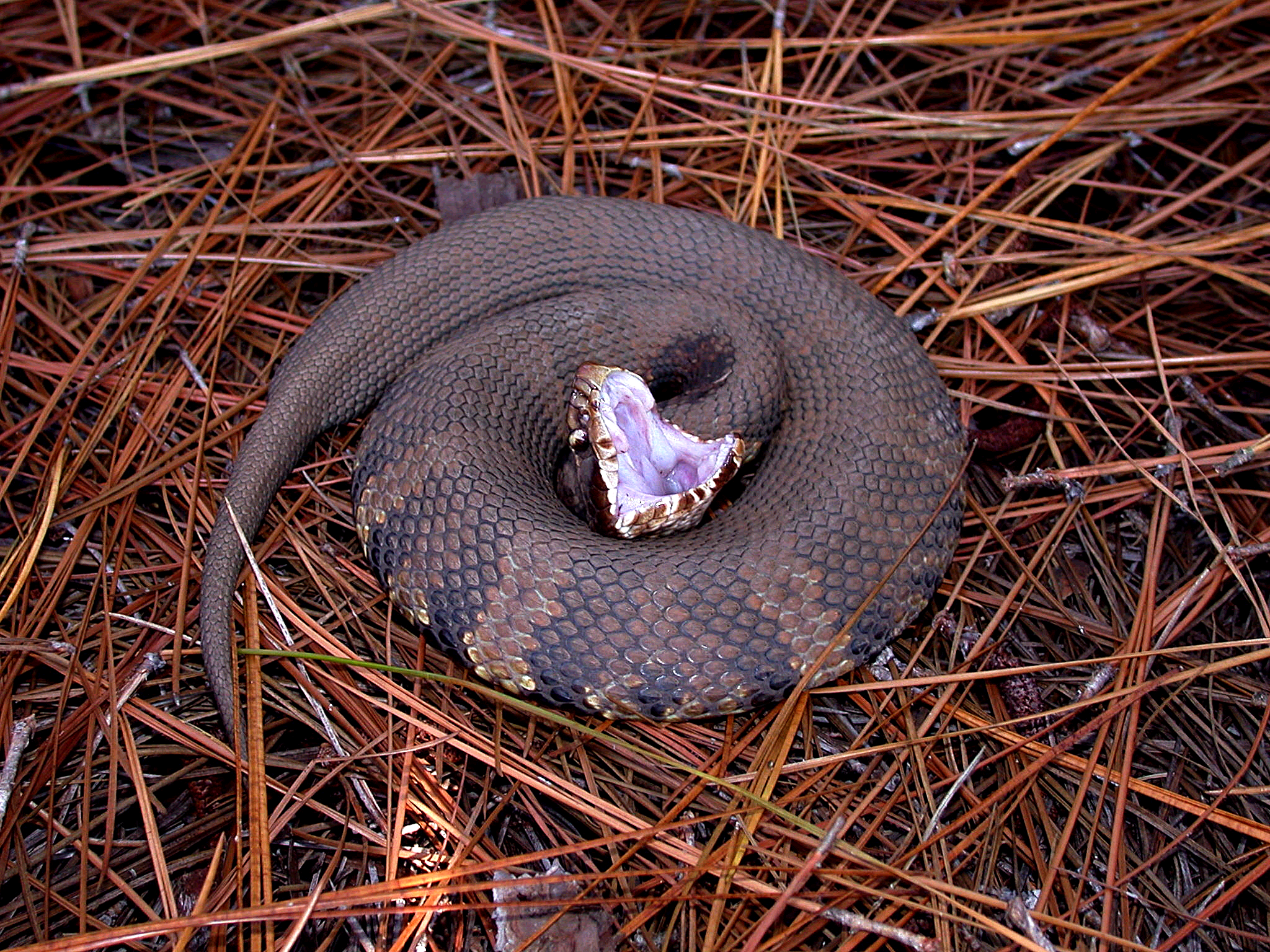
A heavy-bodied venomous semi-aquatic snake with a white "cotton" mouth lining (displayed defensively). Often falsely called "water moccasin" — and often confused with harmless water snakes that share habitats. Bites are serious but rarely fatal with prompt care.
§ Quick facts
§ Encyclopedia
Agkistrodon piscivorus is a species of venomous snake, a pit viper in the subfamily Crotalinae of the family Viperidae. It is one of the world's few semiaquatic vipers, and is native to the Southeastern United States. As an adult, it is large and capable of delivering a painful and potentially fatal bite. When threatened, it may respond by coiling its body and displaying its fangs. Individuals may bite when feeling threatened or being handled in any way. It tends to be found in or near water, particularly in slow-moving and shallow lakes, streams, and marshes. It is a capable swimmer, and like several species of snakes, is known to occasionally enter bays and estuaries and swim between barrier islands and the mainland.
Source: Wikipedia — Agkistrodon piscivorus Licensed under CC BY-SA 4.0
§ Identification
Field marks. Heavy-bodied dark snake (dark brown to nearly black); wider than long; pale cotton-white mouth lining displayed when threatened.
Similar species. Northern Watersnake (non-venomous, more slender). Eastern Mud Snake (smaller, very different head).
Voice. Vibrates tail rapidly. Hisses defensively.
§ Diet & behavior
Diet. Carnivorous: fish, frogs, small birds, mammals.
Behavior. Semi-aquatic — often basking on stream banks. Famously aggressive when threatened, displaying iconic open "cotton" mouth. Bites painful but rarely fatal with treatment.
§ Range
Southeastern US
§ Habitat
Swamps, slow streams, bottomland forests
§ Threats
Killing on sight of any swamp snake (most are harmless), habitat loss, vehicle strikes.
§ Conservation status
According to the IUCN Red List, the cottonmouth is currently classified as Least Concern.
§ What helps
Learn to identify cottonmouth vs. harmless water snakes. Give them space. Support swamp protection.
§ Further reading
- Wikipedia — Agkistrodon piscivorus
- www.nwf.org — authoritative profile of Agkistrodon piscivorus
- IUCN Red List · taxon 64296
- iNaturalist · taxon 30791
- GBIF occurrence records
- Encyclopedia of Life — Agkistrodon piscivorus
§ Sources cited
- The Orianne Society
- Davidson College Department of Biology
- iNaturalist
- IUCN Red List 2007