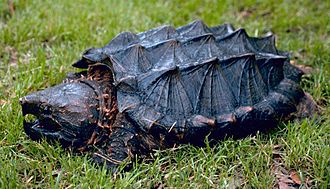
A long-lived (60–80 year) keystone tortoise of the Mojave whose burrows shelter dozens of other species. Populations have declined 90% over the past 50 years.
§ Quick facts
§ Encyclopedia
The desert tortoise is a species of tortoise in the family Testudinidae. The species is native to the Mojave and Sonoran Deserts of the southwestern United States and northwestern Mexico, and to the Sinaloan thornscrub of northwestern Mexico. G. agassizii is distributed in western Arizona, southeastern California, southern Nevada, and southwestern Utah. The specific name agassizii is in honor of Swiss-American zoologist Jean Louis Rodolphe Agassiz. The desert tortoise is the official state reptile in California and Nevada.
Source: Wikipedia — Desert tortoise Licensed under CC BY-SA 4.0
§ Identification
Field marks. Domed dark brown shell; elephantine "club" legs; flattened front feet for digging.
Similar species. Gopher Tortoise (southeastern US; only NA range overlap is none — different ranges).
Voice. Hisses defensively. Generally silent.
§ Diet & behavior
Diet. Strictly herbivorous: grasses, wildflowers, cacti, succulents.
Behavior. Digs deep burrows (up to 9 m long) that provide essential refuge from desert temperature extremes. Aestivates during summer heat; hibernates in winter.
§ Range
Mojave Desert (Arizona, California, Nevada, Utah)
§ Habitat
Creosote-bursage flats, rocky bajadas, washes
§ Threats
Habitat loss to solar development and sprawl, raven predation on hatchlings (subsidized by human food), vehicle strikes, disease.
§ Conservation status
According to the IUCN Red List, the desert tortoise is currently classified as Vulnerable.
§ What helps
Don't handle wild tortoises (it can cause them to release stored water and die of dehydration). Pack out trash to reduce raven populations. Support Mojave conservation.
§ Further reading
- Wikipedia — Desert tortoise
- www.fws.gov — authoritative profile of Gopherus agassizii
- IUCN Red List · taxon 97246272
- iNaturalist · taxon 39825
- GBIF occurrence records
- Encyclopedia of Life — Gopherus agassizii
§ Sources cited
- USFWS Desert Tortoise Recovery
- Desert Tortoise Council
- Mojave Desert Land Trust
- IUCN Red List 2011