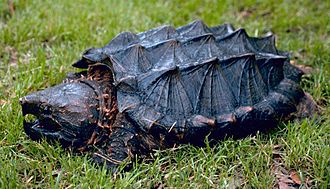
Long-lived terrestrial turtles with high-domed shells and strong site fidelity — they can live 100+ years and rarely leave their home territory.
§ Quick facts
§ Encyclopedia
The eastern box turtle is a subspecies within a group of hinge-shelled turtles normally called box turtles. T. c. carolina is native to the Eastern United States.
Source: Wikipedia — Eastern box turtle Licensed under CC BY-SA 4.0
§ Identification
Field marks. Medium-sized terrestrial turtle with high-domed shell patterned in radiating yellow-orange lines on dark brown background; hinged plastron; males often have red eyes, females brown.
Similar species. Ornate Box Turtle (more western range, flatter shell). Three-toed Box Turtle (subspecies — three rear toes vs. four). Aquatic turtles (no hinged plastron).
Voice. Hisses; juveniles may peep softly.
§ Diet & behavior
Diet. Omnivorous: berries, mushrooms (including some toxic to humans), insects, slugs, worms, occasional small vertebrates. Diet shifts dramatically by age (juveniles more carnivorous, adults more herbivorous).
Behavior. Terrestrial — the only US member of family Emydidae that lives entirely on land. Hinged plastron allows complete closure of shell. Site-fidelity is extreme: individuals can spend their entire lives within a few hectares; if removed and released elsewhere, often die trying to return. State reptile of North Carolina, Tennessee, Mississippi, and Pennsylvania.
§ Range
Eastern US from Maine to Florida and west to the Mississippi River
§ Habitat
Deciduous forests, fields, pastures, and forest edges with moisture
§ Threats
Vehicle collisions, illegal pet trade, habitat fragmentation, slow reproduction (sexual maturity takes 7–10 years).
§ Conservation status
According to the IUCN Red List, the eastern box turtle is currently classified as Vulnerable.
§ What helps
Never relocate a box turtle — they will die trying to return home. Help one cross the road in the direction it's heading.
§ Further reading
- Wikipedia — Eastern box turtle
- www.nwf.org — authoritative profile of Terrapene carolina
- IUCN Red List · taxon 21641
- iNaturalist · taxon 39801
- GBIF occurrence records
- Encyclopedia of Life — Terrapene carolina
§ Sources cited
- Turtle Conservation Coalition
- Box Turtle Conservation Trust
- Davidson College Herpetology Lab
- IUCN Red List 2011