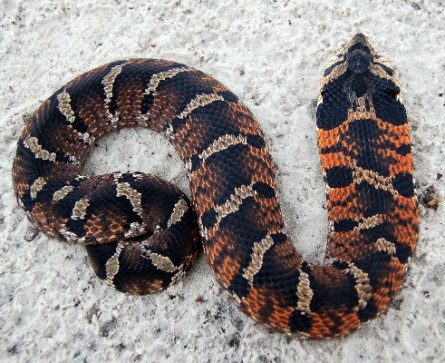
A non-venomous snake with one of the most theatrical defensive displays in nature: hood spreading like a cobra, hissing, and if pressed, rolling over and "playing dead" with mouth open and tongue lolling.
§ Quick facts
§ Encyclopedia
The eastern hog-nosed snake, is a species of mildly venomous rear-fanged snake in the family Colubridae. The venom is specifically adapted to amphibian prey and is harmless to humans. However, some people may have an allergic reaction, and experience local swelling and other symptoms. The species is endemic to North America. There are no subspecies that are recognized as being valid. This species prefers habitats with sandy soils and a combination of grass fields and forest edges. They come in many different colorations and have the identifiable upturned "snout". They can be found in captivity but are a relatively difficult species to keep due to a specialized diet of toads. As with other Heterodon species, they have a distinctive threat reaction of first bluffing by striking with a closed mouth and then pretending to die if this fails to deter the threat.
Source: Wikipedia — Eastern hognose snake Licensed under CC BY-SA 4.0
§ Identification
Field marks. Stocky-bodied snake with upturned snout (used to dig for toads); coloration extremely variable — yellow, brown, gray, olive, or black, often with darker blotches; black-and-white checkered belly.
Similar species. Western Hognose Snake (similar behavior; different range, smaller). Pygmy and Massasauga Rattlesnakes (rattles; venomous; different head shape).
Voice. Loud sustained hiss during defensive display.
§ Diet & behavior
Diet. Almost exclusively toads (resistant to the toxic secretions of Bufo and Anaxyrus species); occasional frogs, salamanders, small reptiles.
Behavior. One of the most theatrical of North American snakes. When threatened, performs an elaborate sequence: first inflates the neck like a cobra hood and hisses loudly; if that fails, flips onto its back, opens mouth, lolls tongue, regurgitates a foul-smelling musk, and plays dead — even if flipped right-side up, immediately rolls back to "dead" position. Has rear-facing fangs and mild venom for subduing toads, but bites toward humans are essentially unknown.
§ Range
Eastern US from southern Ontario to Florida
§ Habitat
Sandy soil, open forests, prairies — wherever toads are abundant
§ Threats
Persecution (mistaken for vipers), vehicle strikes, habitat loss.
§ Conservation status
According to the IUCN Red List, the eastern hognose snake is currently classified as Least Concern.
§ What helps
Learn to identify hognose vs. true vipers. Drive carefully on sandy roads at dusk. Don't kill snakes.
§ Further reading
- Wikipedia — Eastern hognose snake
- www.nwf.org — authoritative profile of Heterodon platirhinos
- IUCN Red List · taxon 63820
- iNaturalist · taxon 29488
- GBIF occurrence records
- Encyclopedia of Life — Heterodon platirhinos
§ Sources cited
- Davidson College Department of Biology
- Virginia Herpetological Society
- iNaturalist
- IUCN Red List 2007