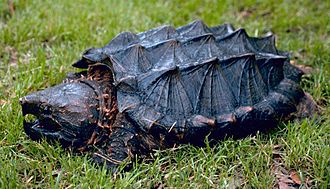
A small, secretive prairie rattlesnake federally Threatened in the US. Critical for wetland ecosystems but persecuted by myth — most people will never see one despite living near populations.
§ Quick facts
§ Encyclopedia
The eastern massasauga is a species of rattlesnake found in eastern North America, from southern Ontario, Canada, eastern regions of the Midwestern states, and parts of the Great Lakes region in the United States. Like all rattlesnakes, it is a pit viper and is venomous; it is the only species of venomous snake in Ontario.
Source: Wikipedia — Eastern massasauga Licensed under CC BY-SA 4.0
§ Identification
Field marks. Small dark gray rattlesnake with darker blotches. Heart-shaped head; relatively small rattle.
Similar species. Pygmy Rattlesnake (smaller). Other rattlesnakes (typically larger). Hognose snakes (non-venomous, no rattle).
Voice. Quiet rattle (smaller than other rattlesnakes).
§ Diet & behavior
Diet. Small mammals (mice, voles), small reptiles, occasionally large insects.
Behavior. Federally threatened in eastern range. Hibernates communally in wetlands. Slow-moving and shy; rattles less and bites less than other rattlers.
§ Range
Great Lakes states and the upper Midwest, parts of Ontario
§ Habitat
Wet meadows, fens, prairie, sedge meadows
§ Threats
Wetland drainage, road mortality, illegal collection, persecution.
§ Conservation status
According to the IUCN Red List, the eastern massasauga is currently classified as Least Concern.
§ What helps
Don't kill any snake on sight. Support wetland conservation. Drive carefully on rural roads in spring and fall.
§ Further reading
- Wikipedia — Eastern massasauga
- www.fws.gov — authoritative profile of Sistrurus catenatus
- IUCN Red List · taxon 64336
- iNaturalist · taxon 30782
- GBIF occurrence records
- Encyclopedia of Life — Sistrurus catenatus
§ Sources cited
- USFWS Eastern Massasauga Recovery
- Toronto Zoo
- iNaturalist
- IUCN Red List 2007