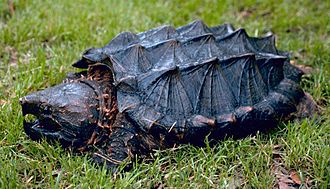
A small dark-brown turtle with a smooth domed shell — often mistakenly considered a "baby snapping turtle" by people who find them crossing roads. Spends most life in shallow water; aestivates buried in mud during drought.
§ Quick facts
§ Encyclopedia
The eastern mud turtle or common mud turtle is a common species of turtle in the family Kinosternidae. The species is endemic to the United States. There are two recognized subspecies.
Source: Wikipedia — Eastern mud turtle Licensed under CC BY-SA 4.0
§ Identification
Field marks. Small dark brown turtle with smooth domed shell; head with two pale yellow stripes from snout through eye; pale yellow chin; hinged plastron.
Similar species. Striped Mud Turtle (with three yellow stripes). Common Musk Turtle (slightly smaller; smaller plastron). Spotted Turtle (yellow spots on shell).
Voice. Hisses defensively; produces strong musky odor from glands when handled.
§ Diet & behavior
Diet. Omnivorous: insects, snails, crayfish, small fish, tadpoles, aquatic plants, carrion.
Behavior. Small terrestrial-aquatic turtle of southeastern wetlands. Spends much of life walking along pond bottoms or floating just below surface. Surprisingly terrestrial for a turtle — frequently observed crossing roads and dry land between water bodies. Hinged plastron allows partial shell closure but does not fully enclose limbs like box turtles. Females nest in sandy soil up to 100 m from water.
§ Range
Southeastern US
§ Habitat
Marshes, swamps, slow streams, ephemeral wetlands
§ Threats
Wetland drainage, road mortality, water-quality decline.
§ Conservation status
According to the IUCN Red List, the eastern mud turtle is currently classified as Least Concern.
§ What helps
Support wetland protection. Slow down on rural roads. Maintain ephemeral pond systems.
§ Further reading
- Wikipedia — Eastern mud turtle
- www.nwf.org — authoritative profile of Kinosternon subrubrum
- IUCN Red List · taxon 163433
- iNaturalist · taxon 39711
- GBIF occurrence records
- Encyclopedia of Life — Kinosternon subrubrum
§ Sources cited
- Turtle Conservation Coalition
- Davidson College Herpetology Lab
- iNaturalist
- IUCN Red List 2011