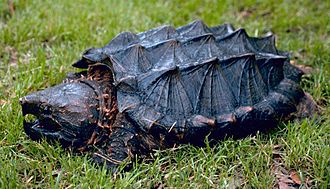
An unusual turtle with a leathery, pancake-flat shell instead of hard scutes. Excellent swimmers with a long snorkel-like nose for breathing while buried in mud. They look almost prehistoric in motion.
§ Quick facts
§ Encyclopedia
The spiny softshell turtle is a species of softshell turtle, one of the largest freshwater turtle species in North America. Both the common name, spiny softshell, and the specific name, spinifera (spine-bearing), refer to the spiny, cone-like projections on the leading edge of the carapace, which are not scutes (scales).
Source: Wikipedia — Spiny softshell turtle Licensed under CC BY-SA 4.0
§ Identification
Field marks. Distinctive flat leathery brown shell with small dark spots and prominent ridges along the front edge (the "spiny" feature); long flexible snorkel-like snout; tube-like nostrils.
Similar species. Smooth Softshell Turtle (no spines; different river systems). Florida Softshell (much larger; different range). Hard-shelled turtles (totally different shell structure).
Voice. Hisses defensively; can deliver painful bite with sharp jaws.
§ Diet & behavior
Diet. Carnivorous: fish, crayfish, aquatic insects, snails, tadpoles, occasional amphibians or carrion.
Behavior. Highly aquatic — spends most of life in water with only nostrils exposed at surface. Pancake-flat leathery shell allows fast swimming and burial in sandy stream bottoms. Can extract oxygen from water through specialized skin in the throat (pharyngeal respiration), allowing hours-long underwater stays. Females migrate up to 1 km to nest on sandy banks; nests vulnerable to raccoons, skunks, and other predators.
§ Range
Eastern US from New York to the Mississippi River
§ Habitat
Large clean rivers and lakes with sandy bottoms
§ Threats
River pollution, sand-mining of nest beaches, road mortality of nesting females.
§ Conservation status
According to the IUCN Red List, the eastern spiny softshell is currently classified as Least Concern.
§ What helps
Reduce sediment and chemical runoff to large rivers. Maintain natural sand beaches. Don't disturb nesting females (May–June).
§ Further reading
- Wikipedia — Spiny softshell turtle
- www.nwf.org — authoritative profile of Apalone spinifera spinifera
- IUCN Red List · taxon 163428
- iNaturalist · taxon 39707
- GBIF occurrence records
- Encyclopedia of Life — Apalone spinifera spinifera
§ Sources cited
- Turtle Conservation Coalition
- Davidson College Herpetology Lab
- iNaturalist
- IUCN Red List 2011