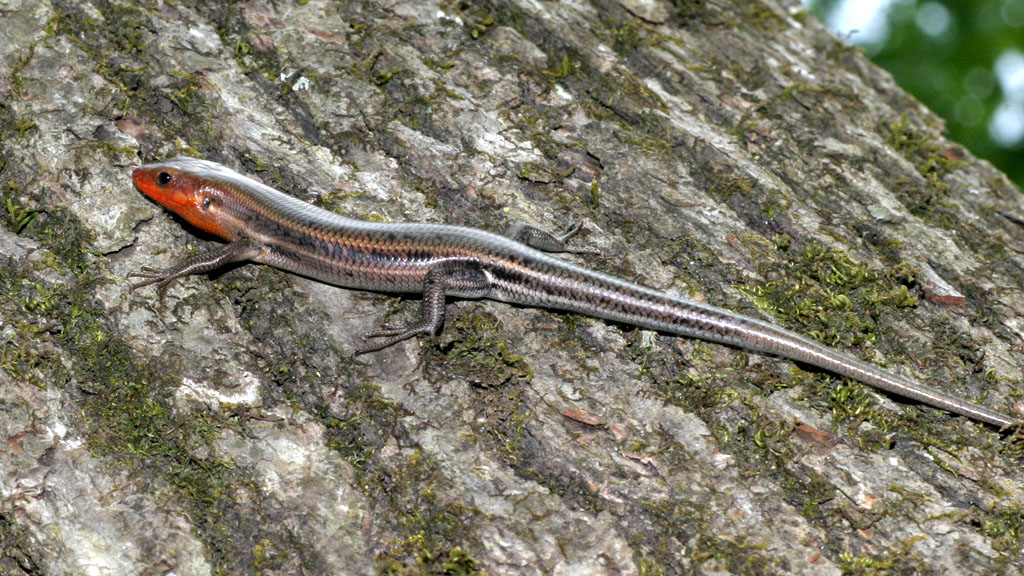
A small smooth-scaled lizard with five pale stripes down a dark body and (in juveniles) a brilliant blue tail. The blue tail breaks off easily and continues to thrash, distracting predators.
§ Quick facts
§ Encyclopedia
The (American) five-lined skink is a species of lizard in the family Scincidae. The species is endemic to North America. It is one of the most common lizards in the Eastern United States and one of the six native species of lizards in Canada.
Source: Wikipedia — Plestiodon fasciatus Licensed under CC BY-SA 4.0
§ Identification
Field marks. Small smooth-scaled lizard. Juveniles: bold black body with five pale yellow stripes from snout through tail; bright electric-blue tail. Adult males: faded stripes; bright orange-red head during breeding. Females: stripes persist; gray-brown body.
Similar species. Broad-headed Skink (much larger; no blue tail as adults). Coal Skink (only four stripes). Six-lined Racerunner (six pale stripes; different body shape).
Voice. N/A
§ Diet & behavior
Diet. Insects (crickets, beetles, grasshoppers, moths), spiders, small invertebrates, occasional smaller lizards.
Behavior. Among the most common lizards in eastern North America. Juveniles have brilliant electric-blue tails and bold dark body with five pale stripes — both serve as anti-predator defenses (the blue tail attracts predator attacks, then breaks off cleanly to allow escape; the stripes confuse depth perception during pursuit). Adult males lose stripes and develop bright orange-red head during breeding season. Females tend egg clutches under bark or in rotted wood — among the few US lizards that guard eggs.
§ Range
Eastern US and southern Canada
§ Habitat
Open deciduous forests, brushy areas, suburban yards with debris piles
§ Threats
Habitat loss, lawn-centric yards, outdoor cat predation.
§ Conservation status
According to the IUCN Red List, the common five-lined skink is currently classified as Least Concern.
§ What helps
Maintain log piles and brushy corners. Skip pesticides. Keep cats indoors.
§ Further reading
- Wikipedia — Plestiodon fasciatus
- www.nwf.org — authoritative profile of Plestiodon fasciatus
- IUCN Red List · taxon 64227
- iNaturalist · taxon 36622
- GBIF occurrence records
- Encyclopedia of Life — Plestiodon fasciatus
§ Sources cited
- Davidson College Department of Biology
- Virginia Herpetological Society
- National Park Service
- IUCN Red List 2007