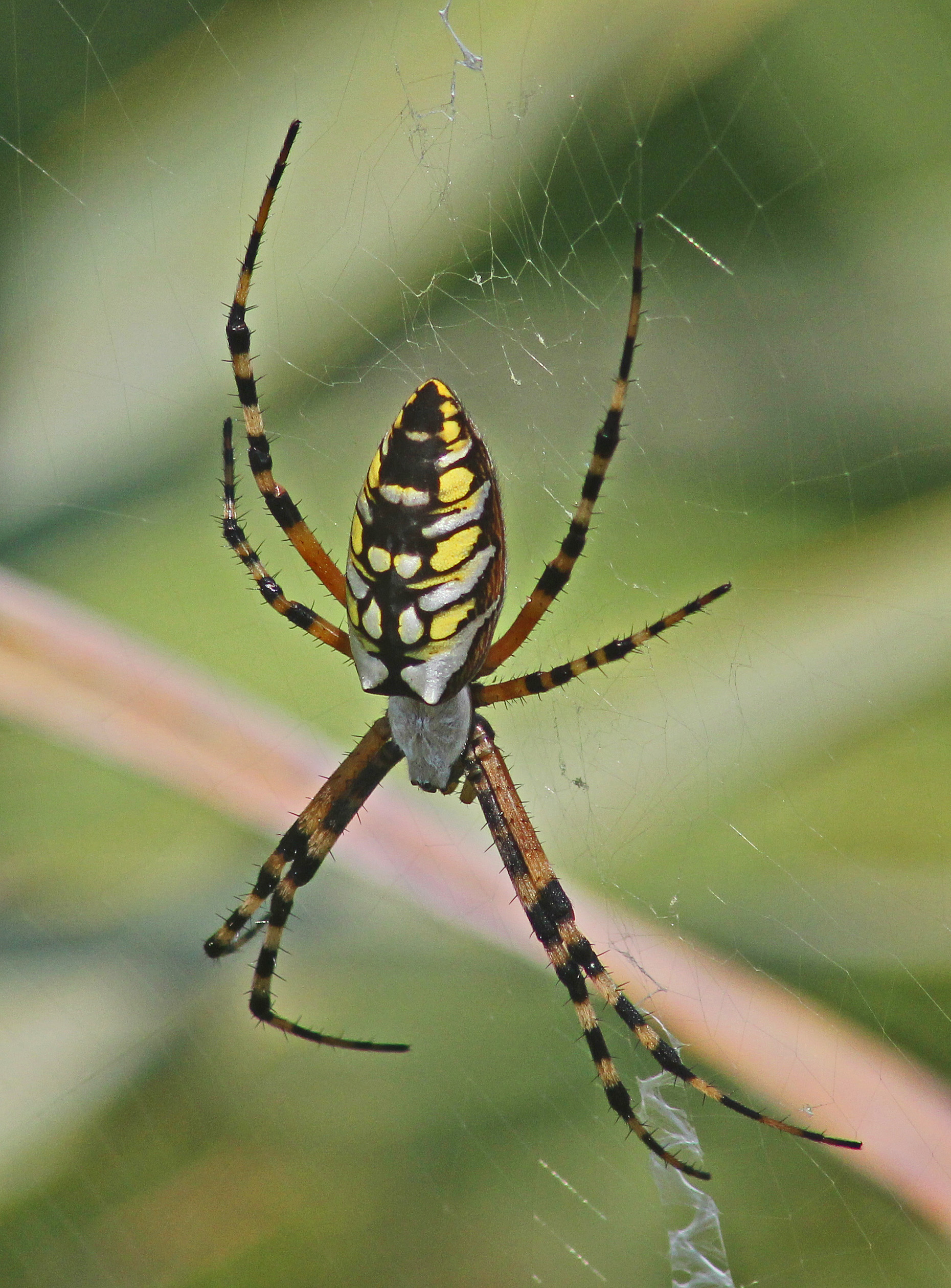
A large striking orb-weaver — black-and-yellow body, banded legs, and characteristic zigzag "stabilimentum" of dense silk down the web center. Builds head-down in a vertical web.
§ Quick facts
§ Encyclopedia
Argiope aurantia is a species of spider, commonly known as the yellow garden spider, black and yellow garden spider, golden garden spider, writing spider, zigzag spider, zipper spider, black and yellow argiope, corn spider, Steeler spider, or McKinley spider. The species was first described by Hippolyte Lucas in 1833. It is common to the contiguous United States, Hawaii, southern Canada, Mexico, and Central America. It has distinctive yellow and black markings on the abdomen and a mostly white cephalothorax. Its scientific Latin name translates to "gilded silver-face". The body length of males range from 5–9 mm (0.20–0.35 in); females range from 19–28 mm (0.75–1.10 in). The average female body mass is about 752.0 mg. These spiders may bite if disturbed or harassed, but the venom is harmless to non-allergic humans, roughly equivalent to a bumblebee sting in intensity.
Source: Wikipedia — Argiope aurantia Licensed under CC BY-SA 4.0
§ Identification
Field marks. Large striking spider with bright yellow-and-black patterned abdomen, banded legs, and bright stabilimentum zigzag at center of web. Females much larger than males.
Similar species. Banded Garden Spider (A. trifasciata; smaller, different pattern). Silver Argiope (silver body). Spinybacked Orb Weaver (different shape, spines on abdomen).
Voice. N/A
§ Diet & behavior
Diet. Flying insects (grasshoppers, bees, flies, butterflies, moths) caught in orb web.
Behavior. Among the most spectacular and visible North American spiders. Females build large vertical orb webs (up to 60 cm diameter) with a distinctive "stabilimentum" — a thick zigzag silk pattern at the web center. Function of the stabilimentum is debated: hypotheses include UV reflection that lures pollinators (yellow garden spiders eat pollinators); structural reinforcement of the web; bird-warning to prevent web destruction; or thermoregulation. Webs torn down nightly and rebuilt at dawn.
§ Range
Across most of North America
§ Habitat
Gardens, meadows, weedy fields, woodland edges
§ Threats
Habitat loss to mowed lawns and row crops, pesticide spraying, overzealous tidying.
§ Conservation status
According to the IUCN Red List, the yellow garden spider is currently classified as Least Concern.
§ What helps
Maintain native plantings. Skip pesticides. Tolerate webs in garden corners.
§ Further reading
- Wikipedia — Argiope aurantia
- www.nwf.org — authoritative profile of Argiope aurantia
- iNaturalist · taxon 48619
- IUCN Red List — search for Argiope aurantia
- GBIF occurrence records
- Encyclopedia of Life — Argiope aurantia
§ Sources cited
- American Arachnological Society
- BugGuide
- University of Florida IFAS Entomology


