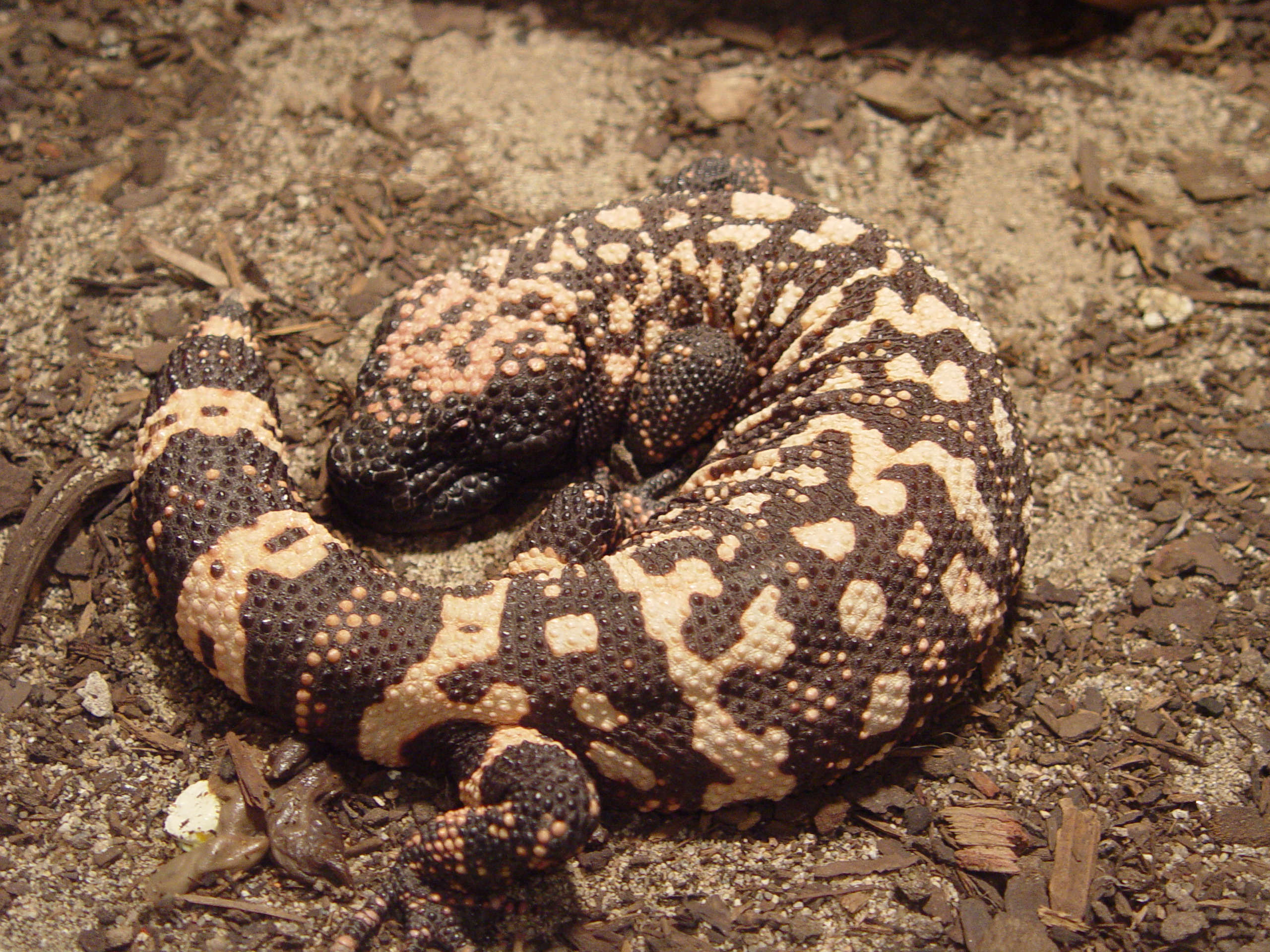
One of only two venomous lizards in the world (the other is its Mexican cousin). Slow-moving, distinctively beaded, they spend 95% of their lives underground or sheltering in rocks.
§ Quick facts
§ Encyclopedia
The Gila monster is a species of venomous lizard native to the Southwestern United States and the northwestern Mexican state of Sonora. It is a heavy, slow-moving reptile, up to 22 in (56 cm) long, and it is the only venomous lizard native to the United States. Its venomous close relatives, the four beaded lizards inhabit Mexico and Guatemala. The Gila monster is sluggish in nature, so it is not generally dangerous and very rarely poses a real threat to humans. Nonetheless, it has a fearsome reputation and is sometimes killed despite the species being protected by state law in Arizona.
Source: Wikipedia — Gila monster Licensed under CC BY-SA 4.0
§ Identification
Field marks. Stout-bodied lizard with bead-like scales in patterns.
Similar species. Beaded Lizard (Mexican). No other native US venomous lizards.
Voice. Hisses defensively.
§ Diet & behavior
Diet. Eggs, hatchlings, small mammals.
Behavior. Slow-moving, mostly underground. Venom delivered through grooved teeth.
§ Range
Sonoran and Mojave deserts of Arizona, southern Nevada, southwest Utah, and northern Mexico
§ Habitat
Rocky desert foothills, oak-juniper woodland, near desert washes
§ Threats
Habitat loss to housing developments, illegal collection for the pet trade, road mortality, persecution.
§ Conservation status
According to the IUCN Red List, the gila monster is currently classified as Near Threatened.
§ What helps
Never collect or relocate. If you see one, photograph and report to AZ Game & Fish or other state agency. Drive cautiously on desert roads at dusk.
§ Further reading
- Wikipedia — Gila monster
- www.fws.gov — authoritative profile of Heloderma suspectum
- IUCN Red List · taxon 9865
- iNaturalist · taxon 28828
- GBIF occurrence records
- Encyclopedia of Life — Heloderma suspectum
§ Sources cited
- Tucson Herpetological Society
- Arizona Game and Fish
- IUCN Red List 2007