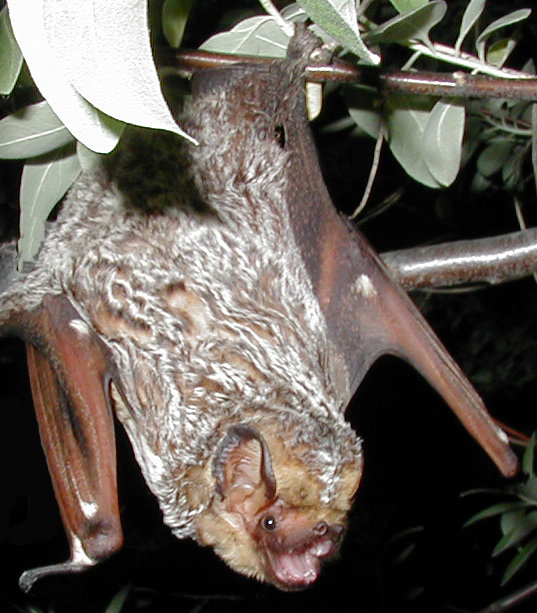
The largest and most widespread bat in North America — a tree-roosting bat with frosted gray-and-brown fur. Migrates long distances annually; tragically suffers extremely high mortality at wind turbines.
§ Quick facts
§ Encyclopedia
The hoary bat is a species of bat in the vesper bat family, Vespertilionidae. It lives throughout most of North America.
Source: Wikipedia — Hoary bat Licensed under CC BY-SA 4.0
§ Identification
Field marks. Large bat with mahogany-brown fur frosted with silver-white tips (the "hoary" appearance); yellow throat; thick fur on tail membrane.
Similar species. Other Lasiurus tree bats (smaller, different coloring — Eastern Red Bat rusty-red; Silver-haired Bat dark with silver). Big Brown Bat (no frosted appearance).
Voice. Loud audible chirps (~12 kHz) — among the few US bats with calls within human hearing range.
§ Diet & behavior
Diet. Large moths (preferred), beetles, dragonflies, mosquitoes, occasional smaller bats.
Behavior. Largest bat in North America. Roosts solitarily in tree foliage rather than caves or buildings — making them less affected by white-nose syndrome but extraordinarily vulnerable to wind turbines. Estimated 800,000+ hoary bats killed annually by wind turbines in North America; turbine mortality may exceed reproductive capacity in some populations. Migratory; populations move between Canadian/northern US summer range and Mexican/Central American wintering grounds.
§ Range
Across most of North America (migratory)
§ Habitat
Roosts in trees; forages over open habitats
§ Threats
Wind turbine collisions (estimated millions of bat deaths annually), pesticide-driven insect declines, deforestation.
§ Conservation status
According to the IUCN Red List, the hoary bat is currently classified as Least Concern.
§ What helps
Support smart wind siting and curtailment during peak migration. Skip pesticides. Plant native trees.
§ Further reading
- Wikipedia — Hoary bat
- www.nwf.org — authoritative profile of Lasiurus cinereus
- IUCN Red List · taxon 11345
- iNaturalist · taxon 40154
- GBIF occurrence records
- Encyclopedia of Life — Lasiurus cinereus
§ Sources cited
- Bat Conservation International
- American Wind Wildlife Institute
- USGS National Wildlife Health Center
- IUCN Red List 2018


