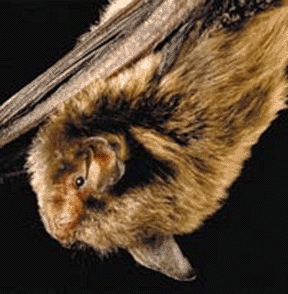
A federally Endangered bat known for hibernating in massive social aggregations of tens of thousands. White-nose syndrome has decimated populations in their hibernation caves — some down 80% since 2006.
§ Quick facts
§ Encyclopedia
The Indiana bat is a medium-sized mouse-eared bat native to North America. It lives primarily in Southern and Midwestern U.S. states and is listed as an endangered species. The Indiana bat is grey, black, or chestnut in color and is 1.2–2.0 in long and weighs 4.5–9.5 g (0.16–0.34 oz). It is similar in appearance to the more common little brown bat, but is distinguished by its feet size, toe hair length, pink lips, and a keel on the calcar.
Source: Wikipedia — Indiana bat Licensed under CC BY-SA 4.0
§ Identification
Field marks. Small brown bat with pinkish-brown belly fur. Calcar (cartilage spur at heel) has a "keel" — useful for in-hand identification.
Similar species. Little Brown Bat (no keeled calcar). Northern Long-eared Bat (longer ears). Tricolored Bat (distinctly tri-colored fur).
Voice. Ultrasonic echolocation calls peaking ~40 kHz (above human hearing).
§ Diet & behavior
Diet. Moths, midges, beetles, and other flying insects caught in flight at 6–30 m above ground.
Behavior. Hibernates in dense clusters of up to 50,000 individuals in specific cool, humid caves and mines. Maternity colonies of 100+ females form under exfoliating bark of large dead or dying trees (shagbark hickory is favored). White-nose syndrome has eliminated 70%+ of the species since 2006.
§ Range
Eastern US, hibernating in caves of Indiana, Kentucky, Missouri
§ Habitat
Caves and abandoned mines (winter); riparian and upland forests (summer)
§ Threats
White-nose syndrome (their primary threat), wind turbine strikes, summer-roost tree removal, cave gates poorly designed.
§ Conservation status
According to the IUCN Red List, the indiana bat is currently classified as Endangered.
§ What helps
Don't enter known hibernacula. Support White-Nose Syndrome research. Choose bat-safe wind-turbine shutdown protocols.
§ Further reading
- Wikipedia — Indiana bat
- www.fws.gov — authoritative profile of Myotis sodalis
- IUCN Red List · taxon 14136
- iNaturalist · taxon 40259
- GBIF occurrence records
- Encyclopedia of Life — Myotis sodalis
§ Sources cited
- USFWS Indiana Bat Recovery
- Indiana State University Center for Bat Research
- IUCN Red List 2018


