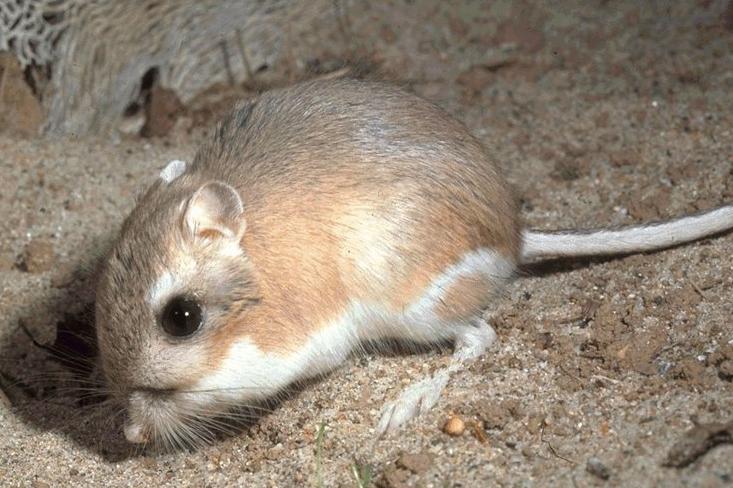
A tiny desert rodent built like a miniature kangaroo — enormous hindlegs, tiny forelimbs, long tufted tail for balance. They never drink water; their bodies extract enough from seeds.
§ Quick facts
§ Encyclopedia
Ord's kangaroo rat is a kangaroo rat native to western North America, specifically the Great Plains and the Great Basin, with its range extending from extreme southern Canada to central Mexico.
Source: Wikipedia — Ord's kangaroo rat Licensed under CC BY-SA 4.0
§ Identification
Field marks. Medium-small rodent with extremely long hind legs; long tail with tuft at tip; small head.
Similar species. Other Dipodomys species (multiple US species).
Voice. Foot-thumping; squeaks.
§ Diet & behavior
Diet. Seeds (primary), green vegetation; can live entire life without drinking water.
Behavior. Most widespread kangaroo rat. Hops on hind legs like a tiny kangaroo. Among the most heat-tolerant North American mammals.
§ Range
Western and central US, into Mexico and Canada
§ Habitat
Sandy desert and grassland with sparse vegetation
§ Threats
Habitat loss to agriculture and solar energy, vehicle strikes, off-road vehicle damage.
§ Conservation status
According to the IUCN Red List, the ord's kangaroo rat is currently classified as Least Concern.
§ What helps
Support careful solar siting. Don't drive off-road in desert. Maintain sandy grassland habitat.
§ Further reading
- Wikipedia — Ord's kangaroo rat
- www.nwf.org — authoritative profile of Dipodomys ordii
- IUCN Red List · taxon 6651
- iNaturalist · taxon 42953
- GBIF occurrence records
- Encyclopedia of Life — Dipodomys ordii
§ Sources cited
- American Society of Mammalogists
- IUCN Red List 2016


