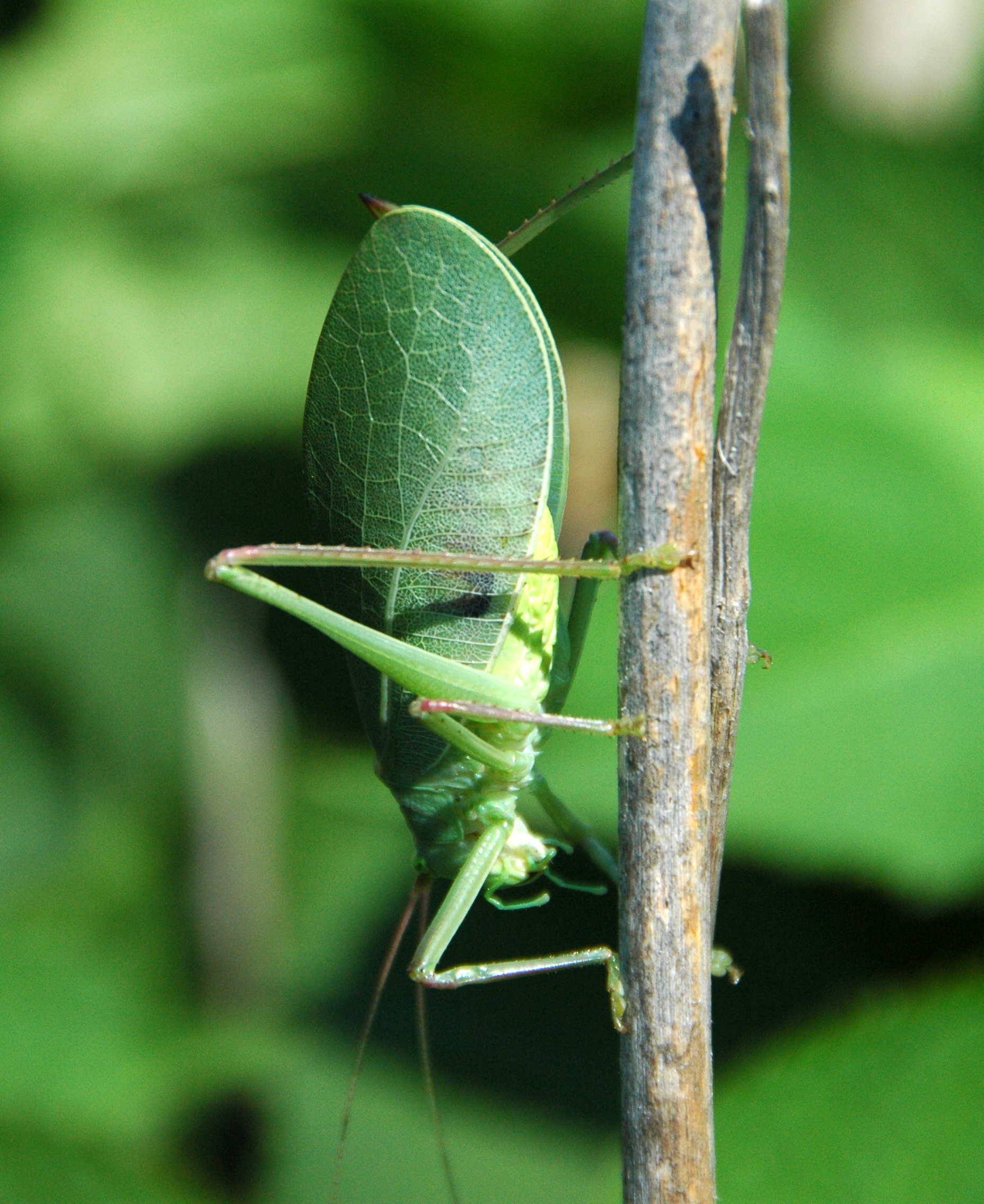
A leaf-mimicking grasshopper relative with broad green wings veined like leaves. Their loud "katy-DID-katy-DIDN'T" calls fill summer nights across the East from late July through frost.
§ Quick facts
§ Encyclopedia
Pterophylla camellifolia, the common true katydid, is a common North American insect. It can be found in southeastern Canada, through the eastern United States from Maine to Florida. P. camellifolia belongs to the family Tettigoniidae (katydids). Within the Tettigoniidae, it belongs to the subfamily Pseudophyllinae. Other common names include northern true katydid and rough-winged katydid.
Source: Wikipedia — Pterophylla camellifolia Licensed under CC BY-SA 4.0
§ Identification
Field marks. Large flat-bodied bright green insect with elongated leaf-shaped wings showing realistic leaf-vein patterning; long thin antennae held back over body.
Similar species. Other katydid species (different sizes, patterns). True crickets (different body shape; different sounds). Long-horned grasshoppers (different shape).
Voice. Loud rasping "ka-ty-DID, ka-ty-DIDN'T" stridulation; among the loudest insect sounds.
§ Diet & behavior
Diet. Leaves of broadleaf trees (oak especially); occasional other foliage. Heavy feeding rarely causes notable damage.
Behavior. Among the loudest insect singers in eastern North America. Males produce the iconic late-summer/fall "ka-ty-DID, ka-ty-DIDN'T" sound at night, often heard from late July through frost. Sound produced by rubbing forewing edges together (stridulation); chorus can be deafening from a single tree. Leaf-mimic body shape — even leaf-vein patterns visible on wings. Difficult to spot despite massive size and incessant noise.
§ Range
Eastern US
§ Habitat
Deciduous forests, suburban tree canopies
§ Threats
Forest loss, light pollution disrupting choruses, pesticide drift.
§ Conservation status
According to the IUCN Red List, the common true katydid is currently classified as Least Concern.
§ What helps
Maintain mature trees. Reduce outdoor lighting. Skip pesticides.
§ Further reading
- Wikipedia — Pterophylla camellifolia
- www.nwf.org — authoritative profile of Pterophylla camellifolia
- iNaturalist · taxon 49245
- IUCN Red List — search for Pterophylla camellifolia
- GBIF occurrence records
- Encyclopedia of Life — Pterophylla camellifolia
§ Sources cited
- BugGuide
- Cornell University Cricket Project
- Songs of Insects (Lang Elliott)
- iNaturalist


