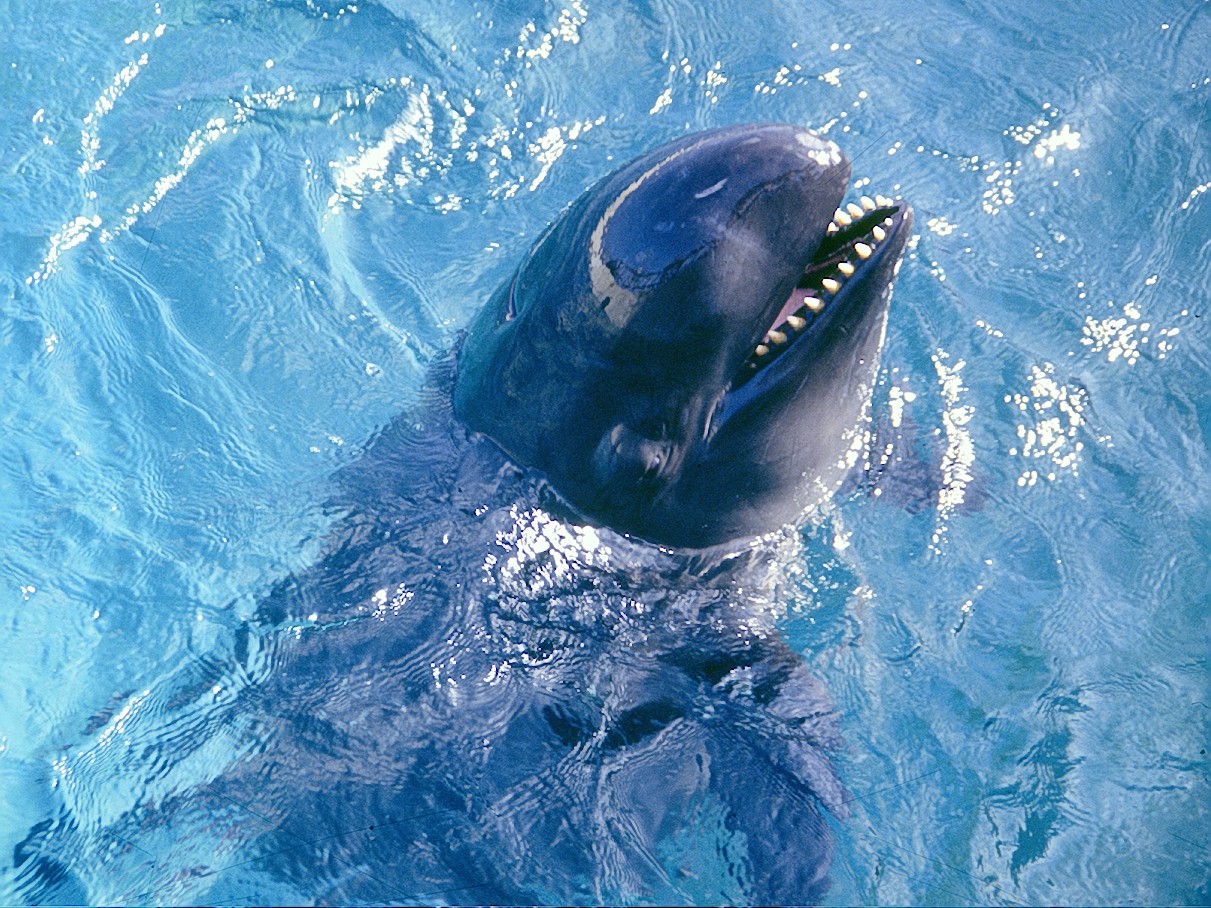
A large dark cetacean closely related to orcas. Live in tight family groups; spectacular acrobatic behaviors.
§ Quick facts
§ Encyclopedia
The false killer whale is a species of oceanic dolphin that is the only extant representative of the genus Pseudorca. It is found in oceans worldwide but mainly in tropical regions. It was first described in 1846 as a species of porpoise based on a skull, which was revised when the first carcasses were observed in 1861. The name "false killer whale" comes from having a skull similar to the orca or killer whale.
Source: Wikipedia — False killer whale Licensed under CC BY-SA 4.0
§ Identification
Field marks. Large dark gray dolphin with slender body; small triangular dorsal fin; melon-shaped head.
Similar species. Orca (Killer Whale; different markings; larger). Pilot Whale (bulbous head).
Voice. Clicks, whistles for echolocation and communication.
§ Diet & behavior
Diet. Fish, squid, marine mammals.
Behavior. Largest member of dolphin family after orca. Despite "killer whale" name, no relation. Live in tight family pods of up to 50+ individuals.
§ Range
Hawaiian Islands and tropical waters
§ Habitat
Pelagic and coastal waters
§ Threats
Fishery interactions, marine plastic, ship strikes.
§ Conservation status
According to the IUCN Red List, the false killer whale is currently classified as Near Threatened.
§ What helps
Support marine mammal protection. Reduce ocean plastic.
§ Further reading
- Wikipedia — False killer whale
- www.fws.gov — authoritative profile of Pseudorca crassidens
- IUCN Red List · taxon 18596
- iNaturalist · taxon 41513
- GBIF occurrence records
- Encyclopedia of Life — Pseudorca crassidens
§ Sources cited
- NOAA Fisheries
- Cascadia Research
- IUCN Red List 2018


