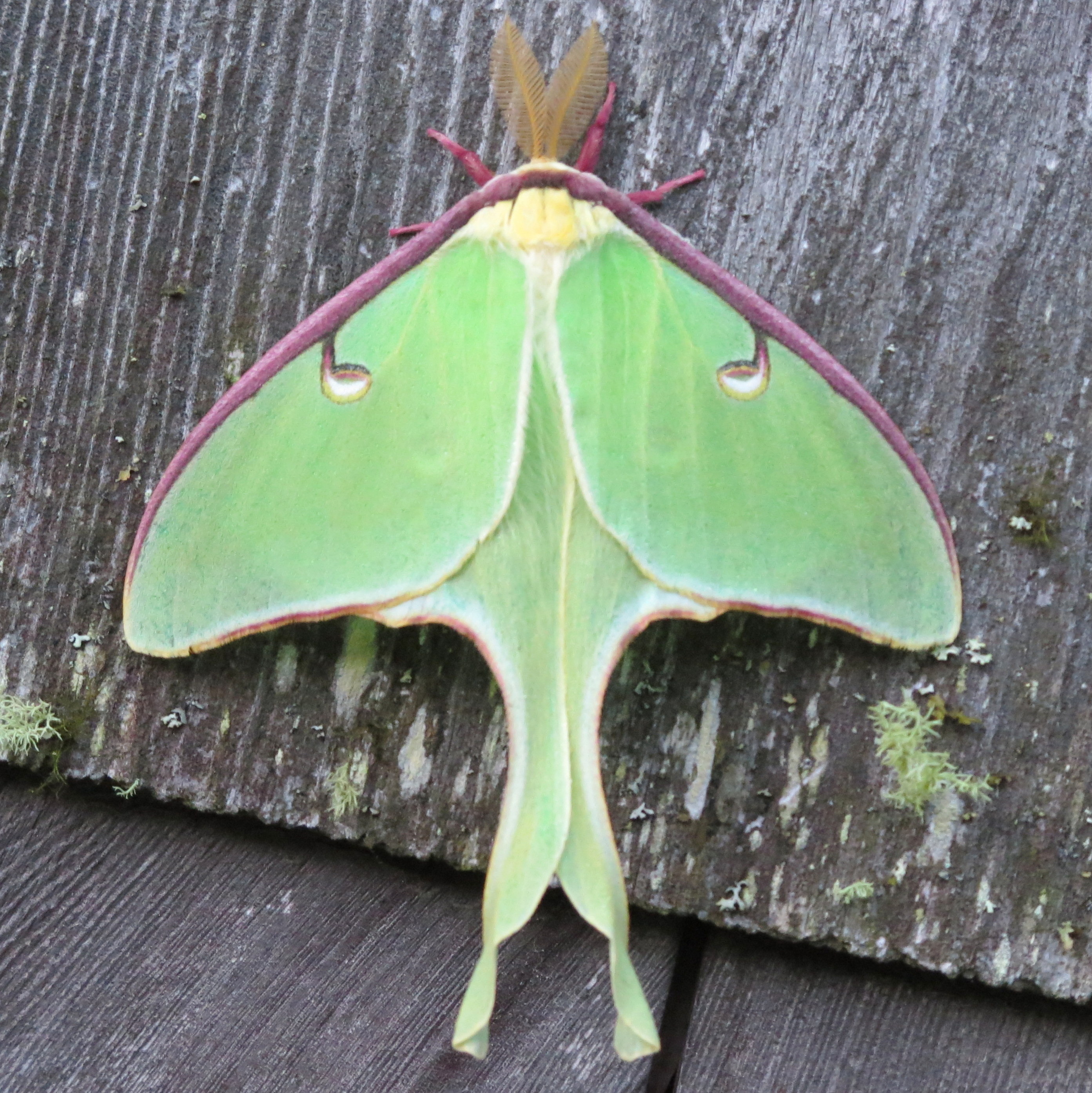
Stunning lime-green silk moths with wingspans up to 4.5 inches and long flowing tails that confuse echolocating bats.
§ Quick facts
§ Encyclopedia
The luna moth, also called the American moon moth, is a Nearctic moth in the family Saturniidae, subfamily Saturniinae, a group commonly named the giant silk moths.
Source: Wikipedia — Luna moth Licensed under CC BY-SA 4.0
§ Identification
Field marks. Pale lime-green wings with long curving tail extensions on hindwings.
Similar species. Polyphemus Moth (tan). Cecropia Moth. Imperial Moth.
Voice. Silent flight; caterpillars click mandibles.
§ Diet & behavior
Diet. Adults: do not eat. Caterpillars: many tree species.
Behavior. Nocturnal. Males locate females via pheromones from miles away.
§ Range
Eastern North America from Canada to northern Mexico
§ Habitat
Deciduous forests with host trees (hickory, walnut, sweetgum, birch)
§ Threats
Light pollution, invasive parasitoid flies introduced for gypsy moth control, habitat fragmentation.
§ Conservation status
According to the IUCN Red List, the luna moth is currently classified as Least Concern.
§ What helps
Turn off porch lights at night. Plant native host trees. Avoid pesticides on host plants.
§ Further reading
- Wikipedia — Luna moth
- www.nwf.org — authoritative profile of Actias luna
- iNaturalist · taxon 49253
- IUCN Red List — search for Actias luna
- GBIF occurrence records
- Encyclopedia of Life — Actias luna
§ Sources cited
- Butterflies and Moths of North America
- Xerces Society
- iNaturalist
- BugGuide


