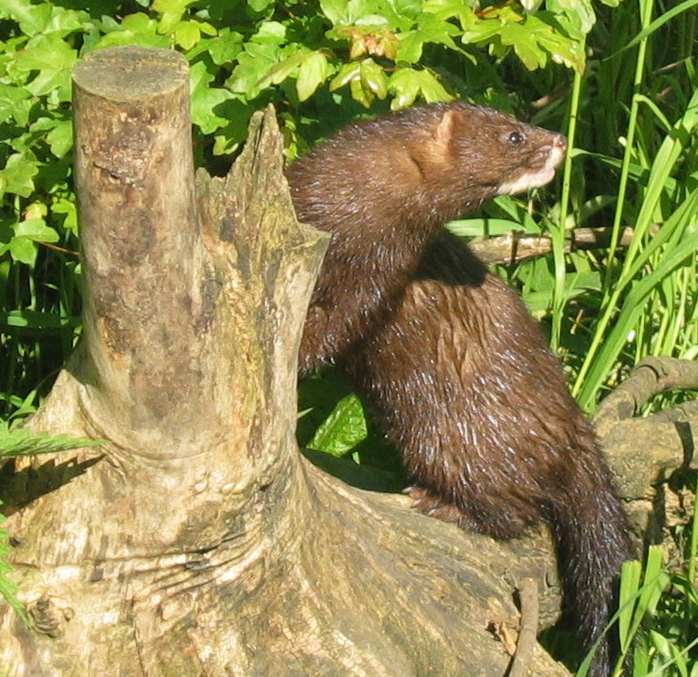
Closely related to North American mink but native to Europe. Historically confused with NA mink which has been introduced to Europe; American mink invasion is the leading driver of European mink decline.
§ Quick facts
§ Encyclopedia
The European mink, also known as the Russian mink and Eurasian mink, is a semiaquatic species of mustelid native to Europe.
Source: Wikipedia — European mink Licensed under CC BY-SA 4.0
§ Identification
Field marks. Small dark brown mustelid with white chin patches.
Similar species. American Mink (similar; larger; introduced in Europe).
Voice. Snarls, hisses.
§ Diet & behavior
Diet. Fish, crustaceans, small mammals, birds, eggs.
Behavior. Eurasian mink species; never naturally occurred in North America. Populations have collapsed across Europe due to introduced American Mink.
§ Range
Europe only — included for educational context
§ Habitat
Riparian (Europe)
§ Threats
In Europe: American mink invasion, habitat loss, pollution.
§ Conservation status
According to the IUCN Red List, the european mink (extinct in na — historical relative) is currently classified as Critically Endangered.
§ What helps
In US: don't release domestic mink. Buy ethically sourced wool/leather alternatives to fur.
§ Further reading
- Wikipedia — European mink
- www.iucnredlist.org — authoritative profile of Mustela lutreola
- IUCN Red List · taxon 14018
- iNaturalist · taxon 41788
- GBIF occurrence records
- Encyclopedia of Life — Mustela lutreola
§ Sources cited
- American Society of Mammalogists
- IUCN Red List 2016


