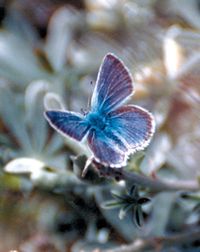
A small blue butterfly federally endangered since 1976. Restricted to coastal lupine grasslands threatened by urbanization, fire suppression, and invasive species.
§ Quick facts
§ Encyclopedia
The Mission blue is a blue or lycaenid butterfly subspecies native to the San Francisco Bay Area of the United States. The butterfly has been declared as endangered by the US federal government. It is a subspecies of Boisduval's blue.
Source: Wikipedia — Mission blue butterfly Licensed under CC BY-SA 4.0
§ Identification
Field marks. Small blue butterfly. Males: brilliant iridescent blue above with thin black border. Females: duller blue-brown; underside silvery-white with rows of small dark spots.
Similar species. Other small blue butterflies in the area (Acmon, Boisduval's; very similar). Tropical Blue (no range overlap). Eastern Tailed-Blue (no tails on Mission Blue).
Voice. N/A
§ Diet & behavior
Diet. Caterpillars feed exclusively on lupines (Lupinus albifrons, L. variicolor, L. formosus). Adults take nectar.
Behavior. Federally endangered (listed 1976) — restricted to San Francisco Bay Area coastal scrub habitats. Adult flight period is just 3–4 weeks in late spring; caterpillars overwinter in lupine seed pods and ant nests. Caterpillars are tended by harvester ants (Camponotus and Formica species) that protect them from parasitoids in exchange for honeydew secretions. Critical conservation work on Twin Peaks, Marin Headlands, and San Bruno Mountain has stabilized populations.
§ Range
San Francisco Bay Area
§ Habitat
Coastal lupine grasslands
§ Threats
Habitat loss to urbanization, fire suppression, invasive plants.
§ Conservation status
According to the IUCN Red List, the mission blue butterfly is currently classified as Endangered.
§ What helps
Support coastal lupine restoration in SF Bay. Donate to Mission Blue Recovery.
§ Further reading
- Wikipedia — Mission blue butterfly
- www.fws.gov — authoritative profile of Icaricia icarioides missionensis
- iNaturalist · taxon 126961
- IUCN Red List — search for Icaricia icarioides missionensis
- GBIF occurrence records
- Encyclopedia of Life — Icaricia icarioides missionensis
§ Sources cited
- USFWS Mission Blue Recovery
- Mission Blue Habitat Conservation Plan
- Pacific Aerospace and Electronics
- iNaturalist


