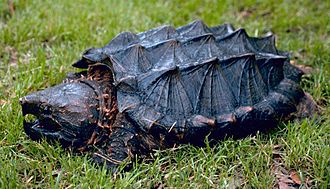
A small dark turtle with a high-domed shell and two pale stripes on the head. Called "stinkpot" for the foul-smelling musk they emit when handled — a deterrent against predators.
§ Quick facts
§ Encyclopedia
Sternotherus odoratus is a species of small turtle in the family Kinosternidae. The species is native to southeastern Canada and much of the Eastern United States. It is also known commonly as the common musk turtle, eastern musk turtle, or stinkpot turtle due to its ability to release a foul musky odor from scent glands on the edge of its shell, possibly to deter predation. This turtle is grouped in the same family as mud turtles.
Source: Wikipedia — Sternotherus odoratus Licensed under CC BY-SA 4.0
§ Identification
Field marks. Small dark brown to nearly black domed-shelled turtle; head with two distinct pale yellow stripes; pale yellow throat; small plastron.
Similar species. Eastern Mud Turtle (slightly larger; less domed shell). Striped Mud Turtle (three yellow stripes). Common Snapping Turtle (much larger; different shape).
Voice. Hisses defensively; produces strong musky odor.
§ Diet & behavior
Diet. Omnivorous: insects, snails, crayfish, tadpoles, small fish, aquatic plants, carrion.
Behavior. Among the smallest US turtles. Common name "Stinkpot" reflects the powerful musky-smelling secretions produced from glands beneath the shell when handled — among the most pungent of any turtle. Highly aquatic but surprisingly arboreal: regularly climbs into low-hanging vegetation along streams and ponds to bask, sometimes startling boaters by falling out of trees.
§ Range
Eastern US
§ Habitat
Slow streams, ponds, lakes
§ Threats
Water-quality decline, shoreline development, illegal collection.
§ Conservation status
According to the IUCN Red List, the eastern musk turtle is currently classified as Least Concern.
§ What helps
Maintain natural shorelines. Don't collect from wild. Support clean water laws.
§ Further reading
- Wikipedia — Sternotherus odoratus
- www.nwf.org — authoritative profile of Sternotherus odoratus
- IUCN Red List · taxon 163427
- iNaturalist · taxon 39733
- GBIF occurrence records
- Encyclopedia of Life — Sternotherus odoratus
§ Sources cited
- Turtle Conservation Coalition
- Davidson College Herpetology Lab
- iNaturalist
- IUCN Red List 2011