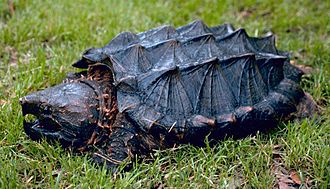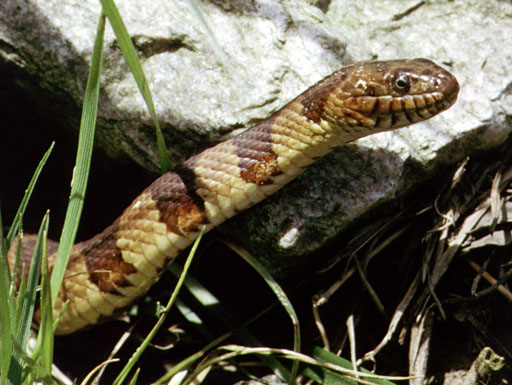
A non-venomous water snake constantly mistaken for the venomous cottonmouth (water moccasin) — and consequently killed by frightened fishermen and homeowners. Their range minimally overlaps with cottonmouths.
§ Quick facts
§ Encyclopedia
The common watersnake is a species of large, nonvenomous, common snake in the family Colubridae. The species is native to North America. It is frequently mistaken for the venomous cottonmouth.
Source: Wikipedia — Common watersnake Licensed under CC BY-SA 4.0
§ Identification
Field marks. Medium-large stocky snake with brown, gray, or reddish-brown body bearing dark crossbands across neck transitioning to alternating blotches mid-body; pale belly with reddish-orange half-moon markings.
Similar species. Cottonmouth (venomous; range only in southeastern US; cotton-white mouth lining when threatened; very different body proportions). Plain-bellied Water Snake (no belly markings).
Voice. Hisses defensively; sometimes vibrates tail rapidly.
§ Diet & behavior
Diet. Fish (~75% of diet), amphibians (frogs, salamanders, tadpoles), crayfish. Catches prey by ambush in water.
Behavior. Frequently misidentified as venomous Cottonmouth (Water Moccasin), leading to needless killing. Northern Water Snake is non-venomous and lives in northern habitats where Cottonmouths do not occur. Defends itself aggressively when handled — bites readily and releases a foul-smelling musk. Bites are non-venomous but inflict significant pain due to needle-like teeth.
§ Range
Eastern and central US, parts of Canada
§ Habitat
Lakes, rivers, ponds, marshes
§ Threats
Persecution from misidentification, vehicle strikes, water pollution.
§ Conservation status
According to the IUCN Red List, the northern water snake is currently classified as Least Concern.
§ What helps
Learn to distinguish water snakes from cottonmouths (vastly different ranges). Don't kill snakes. Support clean water rules.
§ Further reading
- Wikipedia — Common watersnake
- www.nwf.org — authoritative profile of Nerodia sipedon
- IUCN Red List · taxon 63861
- iNaturalist · taxon 29377
- GBIF occurrence records
- Encyclopedia of Life — Nerodia sipedon
§ Sources cited
- Davidson College Department of Biology
- Virginia Herpetological Society
- iNaturalist
- IUCN Red List 2007