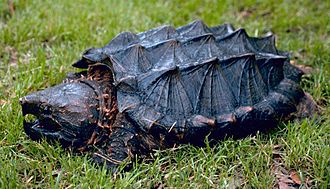
Bright red-and-yellow markings on the shell edges and limbs. Painted turtles are the only North American turtle that survives freezing — hatchlings overwinter in nests with up to 50% body water as ice.
§ Quick facts
§ Encyclopedia
The painted turtle is the most widespread native turtle of North America. It lives in relatively slow-moving fresh waters, from southern Canada to northern Mexico, and from the Atlantic to the Pacific. They have been shown to prefer large wetlands with long periods of inundation and emergent vegetation. This species is one of the few that is specially adapted to tolerate freezing temperatures for extended periods of time due to an antifreeze-like substance in their blood that keeps their cells from freezing. This turtle is a member of the genus Chrysemys, which is part of the pond turtle family Emydidae. Fossils show that the painted turtle existed 15 million years ago. Three regionally based subspecies evolved during the last ice age. The southern painted turtle (C. dorsalis) is alternately considered the only other species in Chrysemys, or another subspecies of C. picta.
Source: Wikipedia — Painted turtle Licensed under CC BY-SA 4.0
§ Identification
Field marks. Smooth oval shell with red markings around edge; yellow stripes on head, neck, and legs; bright red plastron (belly). Four subspecies (Eastern, Midland, Western, Southern) with subtle differences in shell pattern.
Similar species. Red-eared Slider (red ear patch). Pond Sliders (yellow stripes pattern differs). Cooters (different head pattern).
Voice. Hisses defensively.
§ Diet & behavior
Diet. Aquatic plants, algae, insects, snails, fish (live and carrion), tadpoles.
Behavior. Most widespread native US turtle. Active and visible — basks in groups on logs and rocks, often stacked on top of one another. Females migrate hundreds of meters from water to nest in sandy soil, sometimes crossing roads. Hatchlings remain in the nest through their first winter, surviving partial freezing (ice crystallizes in body cavity but glucose protects vital organs).
§ Range
Most of the US and southern Canada — North America's most widespread turtle
§ Habitat
Slow-moving freshwater: ponds, marshes, lake edges with muddy bottoms
§ Threats
Wetland drainage, road mortality (especially nesting females in May–June), illegal collection, raccoon predation of nests.
§ Conservation status
According to the IUCN Red List, the painted turtle is currently classified as Least Concern.
§ What helps
Help turtles cross roads (in the direction they're heading!). Maintain wetland buffer zones. Don't collect from the wild.
§ Further reading
- Wikipedia — Painted turtle
- www.nwf.org — authoritative profile of Chrysemys picta
- IUCN Red List · taxon 163467
- iNaturalist · taxon 39791
- GBIF occurrence records
- Encyclopedia of Life — Chrysemys picta
§ Sources cited
- Turtle Conservation Coalition
- Davidson College Herpetology Lab
- National Audubon Society
- IUCN Red List 2010