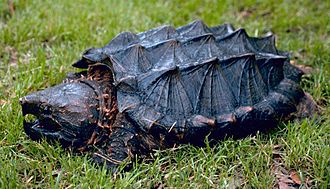
A large non-venomous constrictor with bold black-on-white pattern. Known for fierce defensive displays (loud hissing, head-shaking, false strikes) when threatened — but completely harmless.
§ Quick facts
§ Encyclopedia
Pituophis melanoleucus, commonly known as the eastern pine snake, is a species of nonvenomous snake in the family Colubridae. The species is native to the southeastern United States. Three subspecies are traditionally recognized as being valid, though taxonomic changes may be occurring.
Source: Wikipedia — Pituophis melanoleucus Licensed under CC BY-SA 4.0
§ Identification
Field marks. Large heavy-bodied snake with pointed snout; cream-to-tan body marked with large dark brown to black blotches; northern subspecies more contrasted than black pine snake subspecies (which is nearly all black).
Similar species. Bull Snake (different range; similar size). Eastern Indigo Snake (uniform blue-black). Eastern Ratsnake (different proportions, climbing habit).
Voice. Loud sustained hiss using amplified airway; vibrates tail.
§ Diet & behavior
Diet. Small mammals (rodents primarily), bird eggs, small birds, lizards. Kills by constriction.
Behavior. Large impressive non-venomous snake of southeastern pine flatwoods and sandhills. State-threatened in New Jersey (northern subspecies) and federally threatened (black pine snake subspecies in Alabama-Mississippi). Among the most powerful hissers in the snake world — uses enlarged epiglottis to amplify defensive hissing, sometimes mistaken for a rattlesnake at distance. Excavates underground burrow systems; uses gopher tortoise burrows where available.
§ Range
Eastern US (declining)
§ Habitat
Pine forests, sandhills, open longleaf pine
§ Threats
Loss of longleaf pine habitat, road mortality, persecution from misidentification.
§ Conservation status
According to the IUCN Red List, the northern pine snake is currently classified as Least Concern.
§ What helps
Support longleaf pine restoration. Don't kill snakes. Slow down on rural roads in pine country.
§ Further reading
- Wikipedia — Pituophis melanoleucus
- www.nwf.org — authoritative profile of Pituophis melanoleucus
- IUCN Red List · taxon 63862
- iNaturalist · taxon 29488
- GBIF occurrence records
- Encyclopedia of Life — Pituophis melanoleucus
§ Sources cited
- USFWS Black Pinesnake Recovery
- The Orianne Society
- Davidson College Department of Biology
- IUCN Red List 2007