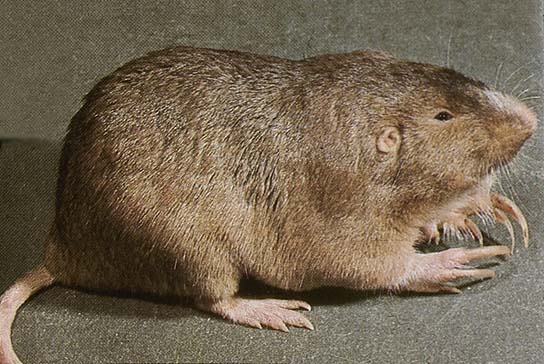
A small burrowing rodent rarely seen above ground — most people know them only from the soil mounds along their tunnels. External fur-lined cheek pouches ("pockets") carry food to underground caches.
§ Quick facts
§ Encyclopedia
The plains pocket gopher is one of 35 species of pocket gophers, so named in reference to their externally located, fur-lined cheek pouches. They are burrowing animals, found in grasslands and agricultural land across the Great Plains of North America, from Manitoba to Texas. Pocket gophers are the most highly fossorial rodents found in North America.
Source: Wikipedia — Plains pocket gopher Licensed under CC BY-SA 4.0
§ Identification
Field marks. Stocky brown rodent with massive front claws; external fur-lined cheek pouches.
Similar species. Other pocket gopher species.
Voice. Generally silent.
§ Diet & behavior
Diet. Roots, tubers, bulbs.
Behavior. Common pocket gopher of central US Great Plains. Important soil engineer.
§ Range
Central US Great Plains
§ Habitat
Grasslands, fields, prairies with loose soil
§ Threats
Habitat loss, lawn-centric yards, persecution as agricultural pests.
§ Conservation status
According to the IUCN Red List, the plains pocket gopher is currently classified as Least Concern.
§ What helps
Tolerate gopher mounds (they aerate soil). Skip rodenticides. Support native prairie.
§ Further reading
- Wikipedia — Plains pocket gopher
- www.nwf.org — authoritative profile of Geomys bursarius
- IUCN Red List · taxon 42598
- iNaturalist · taxon 46032
- GBIF occurrence records
- Encyclopedia of Life — Geomys bursarius
§ Sources cited
- American Society of Mammalogists
- IUCN Red List 2016


