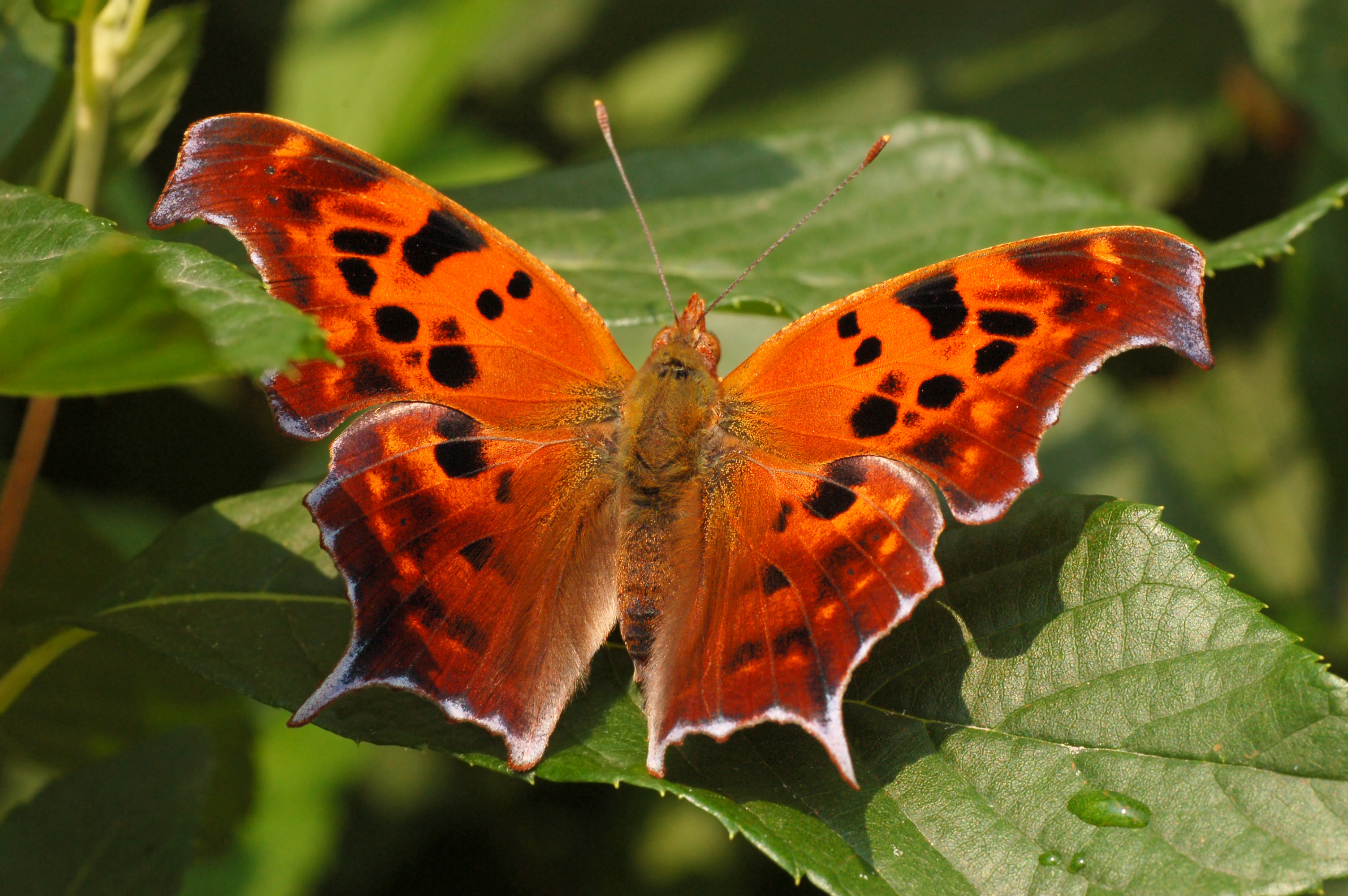
A tawny-orange butterfly with jagged wing margins. Adults overwinter as adults under bark — among very few North American butterflies to do so. The "?" marking on the hindwing underside gives them their name.
§ Quick facts
§ Encyclopedia
Polygonia interrogationis, commonly called the question mark butterfly, is a North American nymphalid butterfly. It lives in wooded areas, city parks, generally in areas with a combination of trees and open space. The color and textured appearance of the underside of its wings combine to provide camouflage that resembles a dead leaf. The adult butterfly has a wingspan of 4.5–7.6 cm (1.8–3.0 in). Its flight period is from May to September. "The silver mark on the underside of the hindwing is broken into two parts, a curved line and a dot, creating a ?-shaped mark that gives the species its common name."
Source: Wikipedia — Polygonia interrogationis Licensed under CC BY-SA 4.0
§ Identification
Field marks. Olive-green above, white below; bold black-and-white face pattern.
Similar species. Warbling Vireo. Other vireos.
Voice. Continuous song from canopy.
§ Diet & behavior
Diet. Caterpillars and insects (primary); berries in late summer.
Behavior. Sings persistently from the canopy.
§ Range
Eastern North America
§ Habitat
Wooded areas, riparian edges, forest openings
§ Threats
Forest loss, removal of standing dead trees and bark, pesticide drift.
§ Conservation status
According to the IUCN Red List, the question mark is currently classified as Least Concern.
§ What helps
Leave dead trees and bark intact. Plant elm and hackberry (caterpillar hosts). Skip pesticides.
§ Further reading
- Wikipedia — Polygonia interrogationis
- www.nwf.org — authoritative profile of Polygonia interrogationis
- IUCN Red List · taxon 22705156
- iNaturalist · taxon 12970
- eBird · reevir1
- GBIF occurrence records
- Encyclopedia of Life — Polygonia interrogationis
§ Sources cited
- Cornell Lab — All About Birds
- National Audubon Society
- iNaturalist
- IUCN Red List 2018


