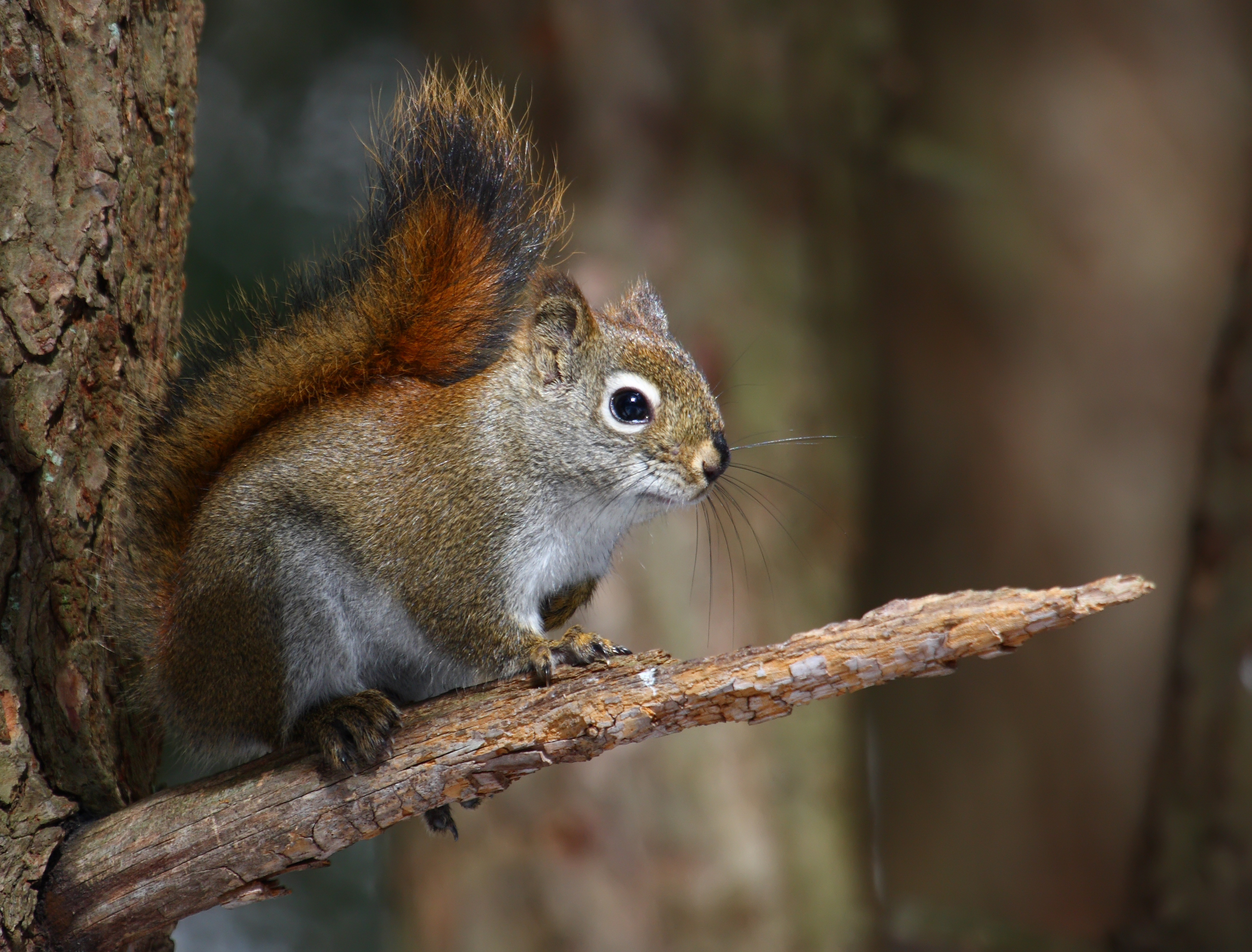
A small bright-rusty squirrel of conifer forests, famous for ferocious territorial chittering from the treetops. They cache conifer cones in massive underground "middens" — some piles built up over generations.
§ Quick facts
§ Encyclopedia
The American red squirrel is one of three species of tree squirrels currently classified in the genus Tamiasciurus, known as the pine squirrels. The American red squirrel is variously known as the pine squirrel or piney squirrel, North American red squirrel, chickaree, boomer, or simply red squirrel. The squirrel is a small, 200–250 g (7.1–8.8 oz), diurnal mammal that defends a year-round exclusive territory. It feeds primarily on the seeds of conifer cones, and is widely distributed across much of the United States and Canada wherever conifers are common, except in the southwestern United States, where it is replaced by the formerly conspecific southwestern red squirrel, and along the Pacific coast of the United States, where its cousin the Douglas squirrel is found instead.
Source: Wikipedia — American red squirrel Licensed under CC BY-SA 4.0
§ Identification
Field marks. Small reddish-brown tree squirrel with white belly; black side stripe in summer; tufted ears in winter.
Similar species. Douglas Squirrel (Pacific Northwest; orange belly). Eastern Gray Squirrel (larger, gray). Fox Squirrel (much larger).
Voice. Loud chattering territorial calls; sharp "queek" alarm calls.
§ Diet & behavior
Diet. Conifer seeds (white spruce especially); mushrooms (caches dried fungi in tree branches), bird eggs and nestlings, insects, occasionally small vertebrates.
Behavior. Highly territorial and noisy. Maintains "middens" of conifer cone scales — debris piles up to 30 m wide and 1 m deep, used continuously by generations of squirrels for centuries. Cones cached in midden remain viable for years; midden temperature/humidity protect them from drying. Among the few mammals known to predate on snowshoe hare leverets.
§ Range
Across boreal and montane North America, Alaska, mountainous US
§ Habitat
Coniferous and mixed forests
§ Threats
Conifer forest loss, climate-driven range shifts, cone-crop failures from changing weather.
§ Conservation status
According to the IUCN Red List, the american red squirrel is currently classified as Least Concern.
§ What helps
Support northern forest protection. Leave dead trees with cavities. Skip seed-bird feeder year-round if reds are aggressive.
§ Further reading
- Wikipedia — American red squirrel
- www.nwf.org — authoritative profile of Tamiasciurus hudsonicus
- IUCN Red List · taxon 42587
- iNaturalist · taxon 46021
- GBIF occurrence records
- Encyclopedia of Life — Tamiasciurus hudsonicus
§ Sources cited
- American Society of Mammalogists
- National Park Service
- Kluane Red Squirrel Project
- IUCN Red List 2016


