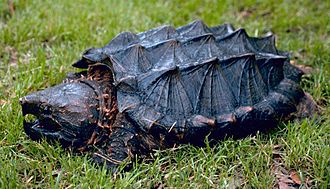
Federally threatened. Among the longest US snakes.
§ Quick facts
§ Encyclopedia
Drymarchon is a genus of large, nonvenomous, colubrid snakes, commonly known as indigo snakes or cribos, found in the Southeastern United States, Mexico, Central America, and South America.
Source: Wikipedia — Drymarchon Licensed under CC BY-SA 4.0
§ Identification
Field marks. Massive glossy blue-black snake with iridescent purple sheen; orange-red throat and chin. Smooth scales.
Similar species. Black Racer (much smaller, dull). Eastern Coachwhip (different pattern, smaller). No other US snake is this large and uniformly blue-black.
Voice. Hisses defensively but rarely aggressive.
§ Diet & behavior
Diet. Other snakes (including venomous pit vipers — immune to their venom), frogs, lizards, small mammals, turtles, eggs. One of the few US snakes that regularly eats other snakes.
Behavior. Largest native US snake. Federally threatened. Inhabits longleaf pine sandhills; depends on gopher tortoise burrows for shelter and overwintering. Diurnal and active even on cold winter days. Non-venomous; kills prey by overpowering. Population reintroductions ongoing in Alabama and Florida.
§ Range
Southeastern US
§ Habitat
Sandhills, pine flatwoods
§ Threats
Habitat loss.
§ Conservation status
According to the IUCN Red List, the indigo snake (eastern) is currently classified as Near Threatened.
§ What helps
Support southeastern pine habitat conservation.
§ Further reading
- Wikipedia — Drymarchon
- www.fws.gov — authoritative profile of Drymarchon couperi
- IUCN Red List · taxon 63769
- iNaturalist · taxon 29508
- GBIF occurrence records
- Encyclopedia of Life — Drymarchon couperi
§ Sources cited
- USFWS Eastern Indigo Recovery
- The Orianne Society
- Central Florida Zoo Conservation
- IUCN Red List 2007