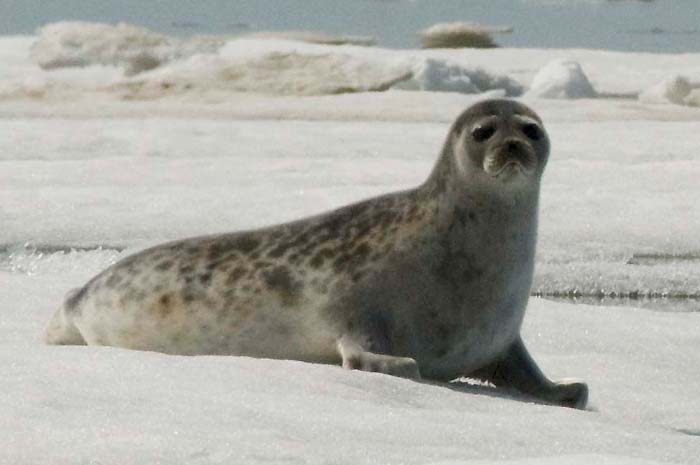
A small Arctic seal — smallest in the Arctic. Primary prey of polar bears. Excavates breathing holes in sea ice and birthing dens in snow drifts.
§ Quick facts
§ Encyclopedia
The ringed seal is a small earless seal species found in Arctic and sub-Arctic regions. Its common name is derived from a distinctive patterning of dark spots surrounded by light gray rings.
Source: Wikipedia — Ringed seal Licensed under CC BY-SA 4.0
§ Identification
Field marks. Small dark seal with distinct dark rings on silver-gray coat; rounded face.
Similar species. Other northern seals (different markings).
Voice. Various trills and growls.
§ Diet & behavior
Diet. Fish (Arctic cod, char), small crustaceans.
Behavior. Most widespread Arctic seal. Builds birthing chambers under snow. Primary prey of polar bears.
§ Range
Arctic seas, Bering Sea
§ Habitat
Sea ice, especially shore-fast ice
§ Threats
Climate-driven sea ice loss, polar bear range shifts, marine pollution.
§ Conservation status
According to the IUCN Red List, the ringed seal is currently classified as Least Concern.
§ What helps
Support Arctic climate action. Reduce fossil fuel emissions. Donate to ringed seal research.
§ Further reading
- Wikipedia — Ringed seal
- www.nwf.org — authoritative profile of Pusa hispida
- IUCN Red List · taxon 41672
- iNaturalist · taxon 41816
- GBIF occurrence records
- Encyclopedia of Life — Pusa hispida
§ Sources cited
- NOAA Fisheries Alaska
- Department of Fisheries and Oceans Canada
- IUCN Red List 2015


