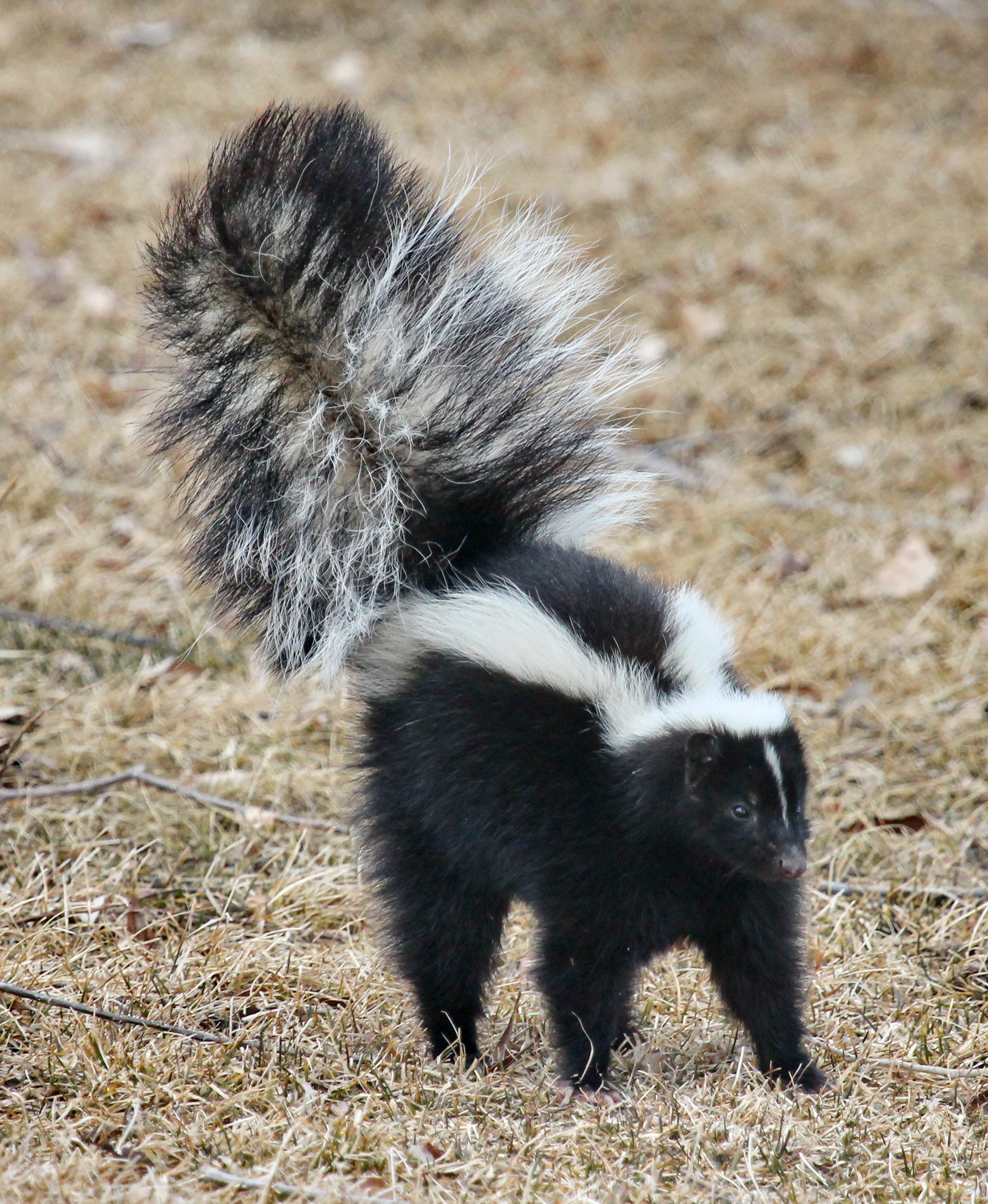
A familiar night-roaming omnivore best known for its potent chemical defense — a sulfur-based spray accurate to 10 feet that deters virtually all predators. They also eat tons of yellow jackets and grubs that damage lawns.
§ Quick facts
§ Encyclopedia
The striped skunk is a skunk of the genus Mephitis that occurs across much of North America, including southern Canada, the United States, and northern Mexico. It is currently listed as least concern by the IUCN on account of its wide range and ability to adapt to human-modified environments.
Source: Wikipedia — Striped skunk Licensed under CC BY-SA 4.0
§ Identification
Field marks. Cat-sized black mammal with two bold white stripes from forehead to tail; bushy black-and-white tail. Considerable individual variation in stripe pattern.
Similar species. Hooded Skunk (longer tail, neck ruff). Spotted Skunk (smaller, distinctive spotted/striped pattern). Hog-nosed Skunk (different snout, mostly white back).
Voice. Hisses, growls, chattering, foot-stamping warnings.
§ Diet & behavior
Diet. Omnivorous: insects (especially grubs and beetles), rodents, eggs, fruits, garbage. Among the few wild mammals that regularly consume honey bee adults — immune to multiple stings.
Behavior. Famous defensive spray from two anal glands — accurate to 3 m, with droplets carrying smell up to 1.5 km. Skunks give multiple warnings before spraying: stamping front feet, raising tail, hissing. Spray contains thiols (the same compounds that give garlic and rotten eggs their smell). Folk hydrogen-peroxide-and-baking-soda formula neutralizes the smell far better than tomato juice (which only masks it).
§ Range
Throughout most of North America from Canada to Mexico
§ Habitat
Forests, grasslands, agricultural areas, suburbs
§ Threats
Vehicle strikes (a major cause of skunk mortality), distemper, rodenticide secondary poisoning.
§ Conservation status
According to the IUCN Red List, the striped skunk is currently classified as Least Concern.
§ What helps
Drive carefully at dusk. Don't kill skunks — they're excellent free pest control. Don't leave pet food out at night.
§ Further reading
- Wikipedia — Striped skunk
- www.nwf.org — authoritative profile of Mephitis mephitis
- IUCN Red List · taxon 41635
- iNaturalist · taxon 41882
- GBIF occurrence records
- Encyclopedia of Life — Mephitis mephitis
§ Sources cited
- American Society of Mammalogists
- USDA Wildlife Services
- IUCN Red List 2016


