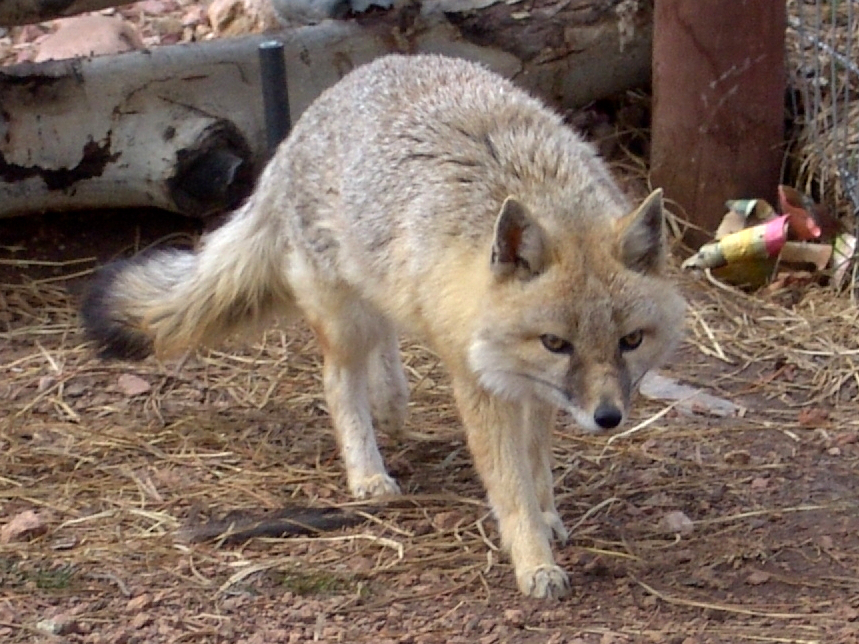
A small fox of open prairie — about the size of a house cat — that nearly vanished from US grasslands by 1930. Successful reintroductions and habitat work have rebuilt populations, but they remain rare.
§ Quick facts
§ Encyclopedia
The swift fox is a small light orange-tan fox around the size of a domestic cat found in the western Great Plains grasslands of North America, such as Montana, Colorado, New Mexico, Kansas, Oklahoma and Texas. It also lives in southern Manitoba, Saskatchewan and Alberta in Canada, where it was previously extirpated. It is closely related to the kit fox and some mammalogists classify them as conspecific. However, molecular systematics imply that the two species are distinct. Interbreeding between the two species does occur where their ranges overlap, but this hybridization is quite restricted in scope.
Source: Wikipedia — Swift fox Licensed under CC BY-SA 4.0
§ Identification
Field marks. Small slender fox with tawny-orange coat; black-tipped tail; large ears.
Similar species. Kit Fox (similar; different range edge). Red Fox (much larger).
Voice. Yips; barks.
§ Diet & behavior
Diet. Small mammals (kangaroo rats, mice), insects.
Behavior. Endemic to North American shortgrass prairies. Among the fastest US foxes (37 mph). Once nearly extirpated; now recovering through reintroduction.
§ Range
Shortgrass prairies of central US and into southern Canada
§ Habitat
Shortgrass and mixed-grass prairie with prairie dog colonies
§ Threats
Conversion of grassland to row crops, secondary rodenticide poisoning, vehicle strikes.
§ Conservation status
According to the IUCN Red List, the swift fox is currently classified as Least Concern.
§ What helps
Support Conservation Reserve Program (CRP). Donate to swift fox recovery. Skip prairie dog poisoning.
§ Further reading
- Wikipedia — Swift fox
- www.nwf.org — authoritative profile of Vulpes velox
- IUCN Red List · taxon 23052
- iNaturalist · taxon 42064
- GBIF occurrence records
- Encyclopedia of Life — Vulpes velox
§ Sources cited
- Swift Fox Conservation Team
- IUCN Red List 2016


