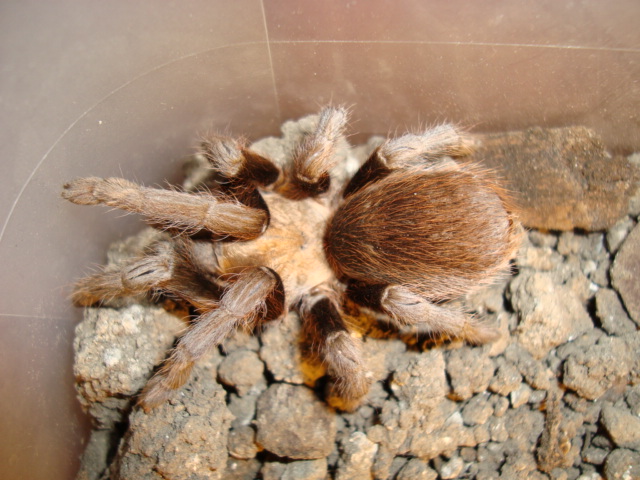
A large hairy spider — leg span up to 4 inches — that lives in silk-lined burrows. Often seen crossing roads in autumn mating season. Bites rarely cause more than bee-sting-level pain.
§ Quick facts
§ Encyclopedia
The Texas brown tarantula, Aphonopelma hentzi, also known as the Oklahoma brown tarantula or Missouri tarantula, is one of the most common species of tarantula living in the Southern United States today. Texas brown tarantulas can grow to leg spans in excess of 10 cm (4 in), and weigh more than 85 g (3 oz) as adults. Their bodies are dark brown, though shades may vary between individual tarantulas. The colors are more distinct after a molt, as with many arthropods. Males develop black legs with a copper colored carapace. Immature and males come in many shades of brown with considerable variation in greys and reds.
Source: Wikipedia — Texas brown tarantula Licensed under CC BY-SA 4.0
§ Identification
Field marks. Medium-large brown tarantula with uniformly dark brown body; lighter brown hairs on legs; no bright markings.
Similar species. Other Aphonopelma species (different ranges, subtle features). Mexican Red-knee Tarantula (introduced via pet trade; bright orange knees).
Voice. Can hiss by rubbing legs (stridulation).
§ Diet & behavior
Diet. Insects (crickets, beetles), other arthropods, small lizards.
Behavior. Most common native US tarantula. Lives in silk-lined burrows in soft soil, emerging at night to ambush prey. Famous for "tarantula migrations" — each fall, mature males (which die within months of mating) cross roads and open ground in massive numbers searching for female burrows, leading to spectacular roadside encounters in central Texas, Oklahoma, and Colorado. Bite is mild and not medically significant; urticating hairs are the primary defense.
§ Range
Texas, Oklahoma, Kansas, Arkansas, Missouri, Louisiana
§ Habitat
Open grasslands, savannas, brushy areas with burrowing soil
§ Threats
Vehicle strikes on rural roads in mating season, habitat loss, capture for pet trade.
§ Conservation status
According to the IUCN Red List, the texas brown tarantula is currently classified as Least Concern.
§ What helps
Drive slowly on rural Texas roads in autumn. Don't collect from wild. Support grassland protection.
§ Further reading
- Wikipedia — Texas brown tarantula
- www.nwf.org — authoritative profile of Aphonopelma hentzi
- iNaturalist · taxon 48619
- IUCN Red List — search for Aphonopelma hentzi
- GBIF occurrence records
- Encyclopedia of Life — Aphonopelma hentzi
§ Sources cited
- American Tarantula Society
- Texas Parks and Wildlife
- American Arachnological Society


