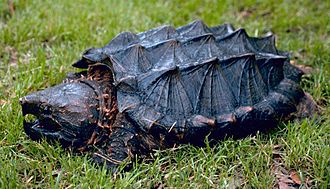
Northeastern subspecies of diamondback terrapin. Critically declined due to crab pot bycatch.
§ Quick facts
§ Encyclopedia
The diamondback terrapin or simply terrapin is a species of terrapin native to the brackish coastal tidal marshes of the East Coast of the United States and the Gulf of Mexico coast, as well as in Bermuda. It belongs to the monotypic genus Malaclemys. It has one of the largest ranges of all turtles in North America, stretching as far south as the Florida Keys and as far north as Cape Cod.
Source: Wikipedia — Diamondback terrapin Licensed under CC BY-SA 4.0
§ Identification
Field marks. Medium turtle with sculpted gray shell pattern of concentric diamonds; pale gray skin with dark spots; black-tipped tail.
Similar species. Map Turtles (freshwater). Painted Turtle (smooth shell, freshwater). No other US turtle inhabits salt marshes.
Voice. Hisses defensively.
§ Diet & behavior
Diet. Periwinkle snails (primary), mussels, fiddler crabs, marsh worms, small fish.
Behavior. The only US turtle that lives exclusively in brackish coastal salt marshes. Specialized salt glands excrete excess salt from sea water. Females migrate inland to lay eggs on sandy banks — a behavior that exposes them to vehicle strikes on coastal roads and crab-pot drowning. Major historical decline from being eaten as a delicacy (1900s "terrapin soup").
§ Range
Atlantic coast from MA to NC
§ Habitat
Coastal salt marshes, estuaries
§ Threats
Crab pot bycatch, road mortality during nesting, illegal collection.
§ Conservation status
According to the IUCN Red List, the diamondback terrapin (mid-atlantic) is currently classified as Near Threatened.
§ What helps
Support bycatch reduction in crab pots. Drive slowly near coastal areas.
§ Further reading
- Wikipedia — Diamondback terrapin
- www.fws.gov — authoritative profile of Malaclemys terrapin terrapin
- IUCN Red List · taxon 12695
- iNaturalist · taxon 39860
- GBIF occurrence records
- Encyclopedia of Life — Malaclemys terrapin terrapin
§ Sources cited
- Diamondback Terrapin Working Group
- Wetlands Institute
- NOAA Northeast Fisheries
- IUCN Red List 2010