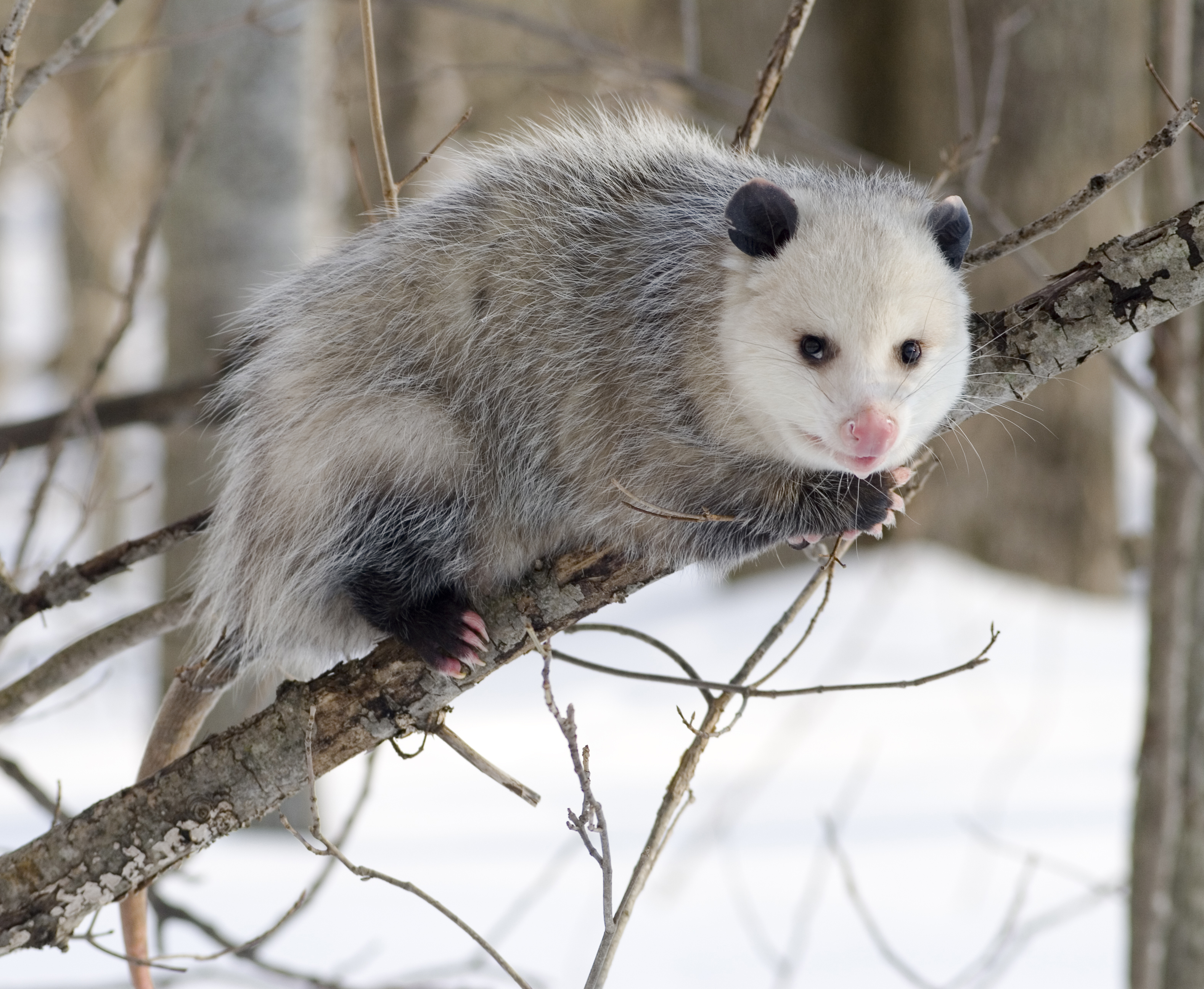
North America's only marsupial — and one of its most underappreciated. Opossums are nearly immune to rabies, eat 5,000+ ticks per season per individual, and possess one of the longest lists of skill-set tools in the mammal world.
§ Quick facts
§ Encyclopedia
The Virginia opossum, also known as the North American opossum, is a member of the opossum family found from southern Canada to northern Costa Rica, making it the northernmost marsupial in the world. Commonly referred to simply as the possum, it is a solitary nocturnal animal about the size of a domestic cat, and a successful opportunist.
Source: Wikipedia — Virginia opossum Licensed under CC BY-SA 4.0
§ Identification
Field marks. Cat-sized grayish-white mammal with naked pink ears, pointed white face, long naked prehensile pink-and-black tail, hand-like opposable thumbs on hind feet.
Similar species. Raccoon (masked face, ringed tail, larger). Other US mammals lack the combination of pouch, prehensile tail, and opposable thumbs.
Voice. Generally silent. Hisses, growls, screeches when threatened; young click and chirp.
§ Diet & behavior
Diet. Omnivorous: insects, small vertebrates, fruits, eggs, carrion, garbage, pet food. Famously eats ticks — laboratory studies show a single opossum can groom and ingest 5,000+ ticks per season.
Behavior. Only marsupial native to north of Mexico. Pre-mammalian feature retained: females carry 4–13 tiny embryonic newborns (the size of honey bees) in a pouch for ~70 days until they emerge furred and mobile. Famous "playing possum" — an involuntary catatonic state triggered by extreme stress; opossum collapses with mouth open, drooling, and emits a foul carrion-like smell from anal glands.
§ Range
Eastern and central US, expanding north and west
§ Habitat
Forests, grasslands, suburbs, near water
§ Threats
Vehicle strikes (a major cause of opossum mortality), persecution, dog attacks, secondary rodenticide poisoning.
§ Conservation status
According to the IUCN Red List, the virginia opossum is currently classified as Least Concern.
§ What helps
Drive carefully at dawn/dusk. Don't persecute opossums — they're tick-eating allies. Keep dogs leashed.
§ Further reading
- Wikipedia — Virginia opossum
- www.nwf.org — authoritative profile of Didelphis virginiana
- IUCN Red List · taxon 40502
- iNaturalist · taxon 41462
- GBIF occurrence records
- Encyclopedia of Life — Didelphis virginiana
§ Sources cited
- American Society of Mammalogists
- Cary Institute of Ecosystem Studies (tick study)
- National Wildlife Federation
- IUCN Red List 2016


