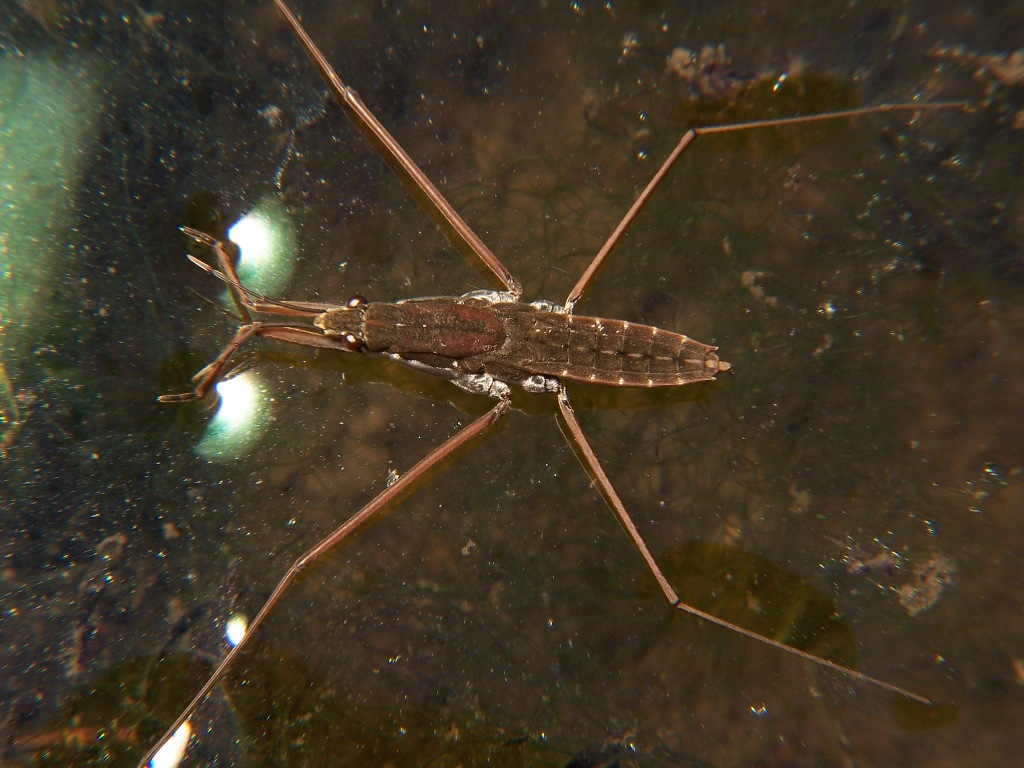
A long-legged surface-skater that exploits water tension. Their feet are coated in tiny hairs that repel water — they essentially walk on water.
§ Quick facts
§ Encyclopedia
Aquarius remigis, known as the common water strider, is a species of aquatic bug. It was formerly known as Gerris remigis, but the subgenus Aquarius was elevated to generic rank in 1990 on the basis of phylogenetic analysis. Aquarius remigis is found throughout North America, but is most prevalent in the mid-west of the United States.
Source: Wikipedia — Aquarius remigis Licensed under CC BY-SA 4.0
§ Identification
Field marks. Slender dark brown to black insect on water surface; long thin legs splayed wide; the middle pair of legs provides propulsion, the back pair steering; the small front pair grasps prey.
Similar species. Other Gerridae species (different sizes). Backswimmers (under water, dive-style swimmers).
Voice. Some species use ripple-pattern signaling for communication.
§ Diet & behavior
Diet. Insects and other arthropods trapped at the water surface — flies, mosquitoes, ants, fallen prey.
Behavior. Among the most familiar pond insects. Walks on water using surface tension — special hydrophobic hairs (1,000+ per mm² on legs) trap a thin air layer that prevents legs from breaking through the water surface. Can reach speeds of 1.5 m/s on water; in escape mode, can leap 30 cm. Uses ripples generated by struggling prey as locator signal; sensitive enough to detect a single insect leg landing on water from 30 cm away.
§ Range
Across North America
§ Habitat
Pond, lake, and stream surfaces
§ Threats
Water pollution, oil spills (break surface tension), pesticide drift.
§ Conservation status
According to the IUCN Red List, the common water strider is currently classified as Least Concern.
§ What helps
Support clean ponds. Skip pesticides. Don't release aquarium pets.
§ Further reading
- Wikipedia — Aquarius remigis
- www.nwf.org — authoritative profile of Aquarius remigis
- iNaturalist · taxon 71355
- IUCN Red List — search for Aquarius remigis
- GBIF occurrence records
- Encyclopedia of Life — Aquarius remigis
§ Sources cited
- BugGuide
- University of California IPM
- iNaturalist


