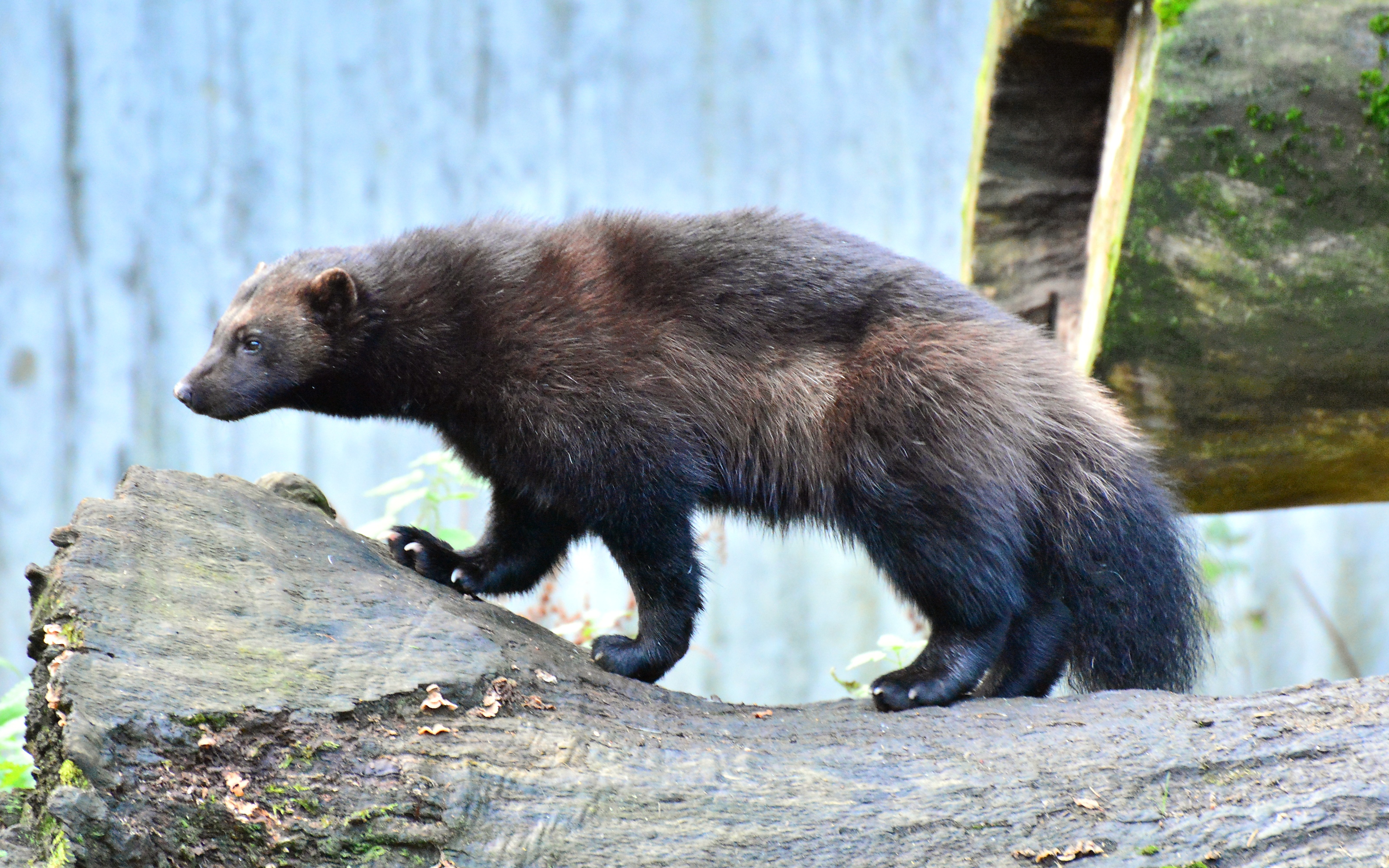
The largest land-dwelling member of the weasel family and one of North America's rarest carnivores. Estimated US population in the lower 48 is fewer than 300 — they need persistent spring snow to den.
§ Quick facts
§ Encyclopedia
The wolverine, also called the carcajou or quickhatch, is the largest land-dwelling member of the family Mustelidae. It is a muscular carnivore and a solitary animal. The wolverine has a reputation for ferocity and strength out of proportion to its size, with the documented ability to kill prey many times larger than itself.
Source: Wikipedia — Wolverine Licensed under CC BY-SA 4.0
§ Identification
Field marks. Looks like small bear with long tail. Dark brown with pale saddle stripes.
Similar species. American Badger. Hoary Marmot.
Voice. Hisses, growls.
§ Diet & behavior
Diet. Carrion (primary), small mammals.
Behavior. Solitary; ranges enormously across mountain terrain.
§ Range
Boreal North America; in lower 48 only in Cascades, Northern Rockies, Sierra Nevada
§ Habitat
Remote subalpine forests, alpine tundra, deep snowpack
§ Threats
Climate-driven loss of late-spring snowpack, low natural densities, trapping in some jurisdictions, road and trail disturbance.
§ Conservation status
According to the IUCN Red List, the wolverine is currently classified as Least Concern.
§ What helps
Support climate action. Donate to wolverine recovery groups. Avoid back-country travel near known dens (May–June).
§ Further reading
- Wikipedia — Wolverine
- www.fws.gov — authoritative profile of Gulo gulo
- IUCN Red List · taxon 9561
- iNaturalist · taxon 41834
- GBIF occurrence records
- Encyclopedia of Life — Gulo gulo
§ Sources cited
- Wolverine Foundation
- USFWS
- IUCN Red List 2016


