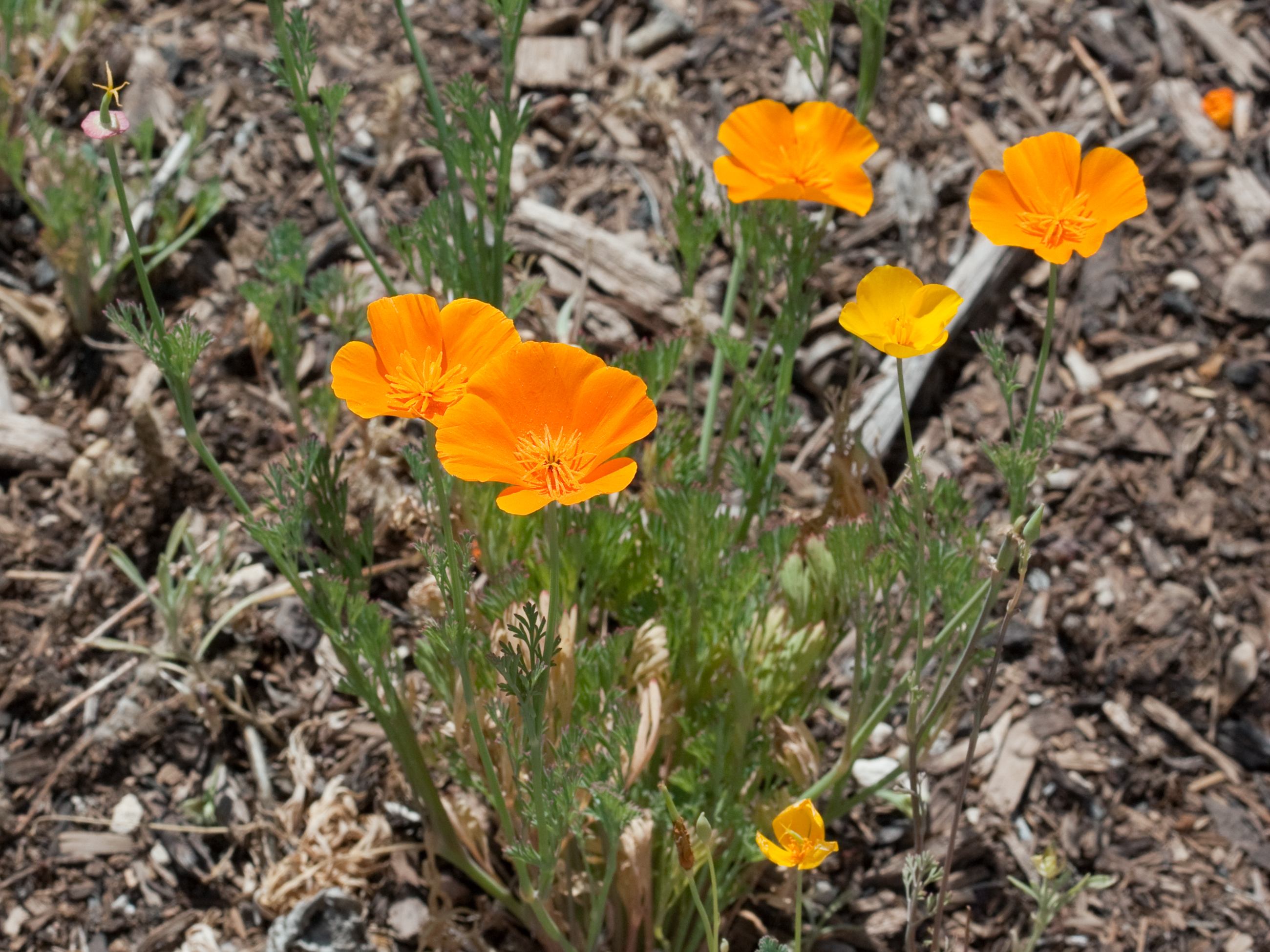
California's state flower and the reason whole hillsides turn fluorescent orange after wet winters — a "superbloom" event that draws crowds (and unfortunately damages habitat when visitors trample beyond paths).
§ Quick facts
§ Encyclopedia
Eschscholzia californica, the California poppy, golden poppy, Mexican poppy, California sunlight or cup of gold, is a species of flowering plant in the family Papaveraceae, native to the United States and Mexico. It is cultivated as an ornamental plant flowering in summer, with showy flowers in brilliant shades of red, orange and yellow. It is also used as food or a garnish. It had various uses in indigenous herbalism. It became the official state flower of California in 1903.
Source: Wikipedia — Eschscholzia californica Licensed under CC BY-SA 4.0
§ Identification
Field marks. Blue-green divided leaves; cup-shaped 4-petaled flowers.
Similar species. Mexican Gold Poppy. Iceland Poppy (multiple colors).
Voice. N/A
§ Diet & behavior
Diet. N/A — photosynthesis
Behavior. Native California wildflower famously carpets hillsides bright orange in spring.
§ Range
California through Oregon, Mexico; introduced widely as garden plant
§ Habitat
Open slopes, grasslands, roadsides, and chaparral edges
§ Threats
Habitat conversion, invasive grasses outcompeting natives, illegal harvest from wild populations, social-media-driven trampling.
§ Conservation status
According to the IUCN Red List, the california poppy is currently classified as Least Concern.
§ What helps
Stay on designated trails during superblooms. Plant native (not garden) California poppy. Support California state park funding.
§ Further reading
- Wikipedia — Eschscholzia californica
- www.nps.gov — authoritative profile of Eschscholzia californica
- iNaturalist · taxon 48580
- IUCN Red List — search for Eschscholzia californica
- GBIF occurrence records
- Encyclopedia of Life — Eschscholzia californica
§ Sources cited
- Theodore Payne Foundation
- California Native Plant Society
- iNaturalist


