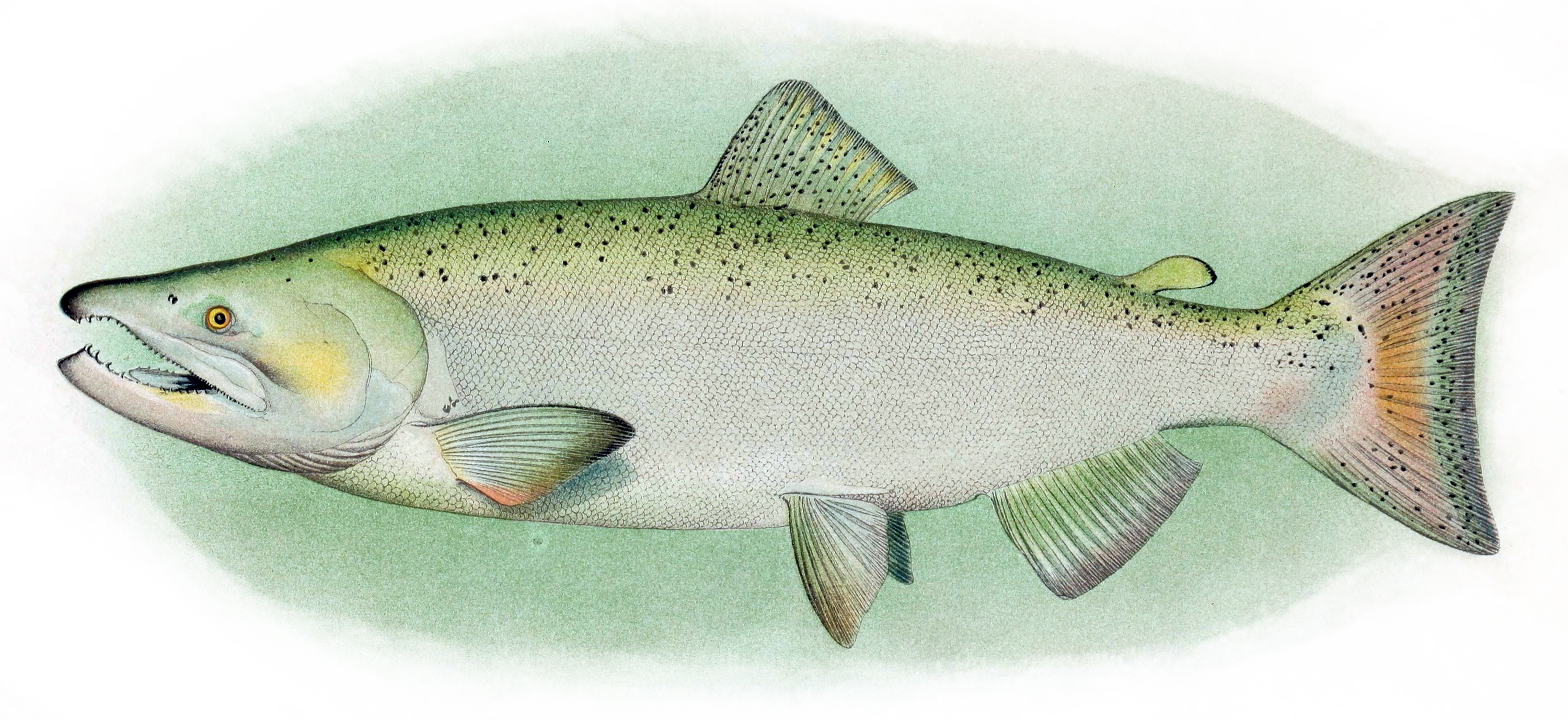
The largest of the Pacific salmon and the cornerstone of Pacific Northwest ecosystems — feeding orcas, bears, eagles, and even forests via marine-derived nitrogen carried inland by their decomposing bodies.
§ Quick facts
§ Encyclopedia
The Chinook salmon is the largest and most valuable species of Pacific salmon. Its common name is derived from the Chinookan peoples. Other vernacular names for the species include king salmon, quinnat salmon, tsumen, spring salmon, blackmouth, and tyee salmon. The scientific species name is based on the Russian common name chavycha (чавыча).
Source: Wikipedia — Chinook salmon Licensed under CC BY-SA 4.0
§ Identification
Field marks. Silvery body with small black spots; black gum line distinguishes from coho. Spawning fish turn reddish or olive.
Similar species. Coho Salmon (white gums). Sockeye (different body shape).
Voice. Silent.
§ Diet & behavior
Diet. At sea: smaller fish (herring, smelt). In fresh water: stops eating during spawning.
Behavior. Largest Pacific salmon. Anadromous; spawning fish die after spawning, providing critical marine-derived nutrients to forest ecosystems.
§ Range
North Pacific from California to Alaska, spawning in coastal rivers
§ Habitat
Cold, clean rivers with gravel bottoms (spawning); North Pacific (adult)
§ Threats
Dams blocking spawning rivers, warming water, lost estuary habitat, hatchery overreliance reducing wild diversity.
§ Conservation status
According to the IUCN Red List, the chinook salmon is currently classified as Near Threatened.
§ What helps
Support dam removal where viable. Choose sustainable wild-caught salmon. Donate to riparian restoration projects.
§ Further reading
- Wikipedia — Chinook salmon
- www.fisheries.noaa.gov — authoritative profile of Oncorhynchus tshawytscha
- IUCN Red List · taxon 135301
- iNaturalist · taxon 49587
- GBIF occurrence records
- Encyclopedia of Life — Oncorhynchus tshawytscha
§ Sources cited
- NOAA Fisheries
- Wild Salmon Center
- IUCN Red List 2018


