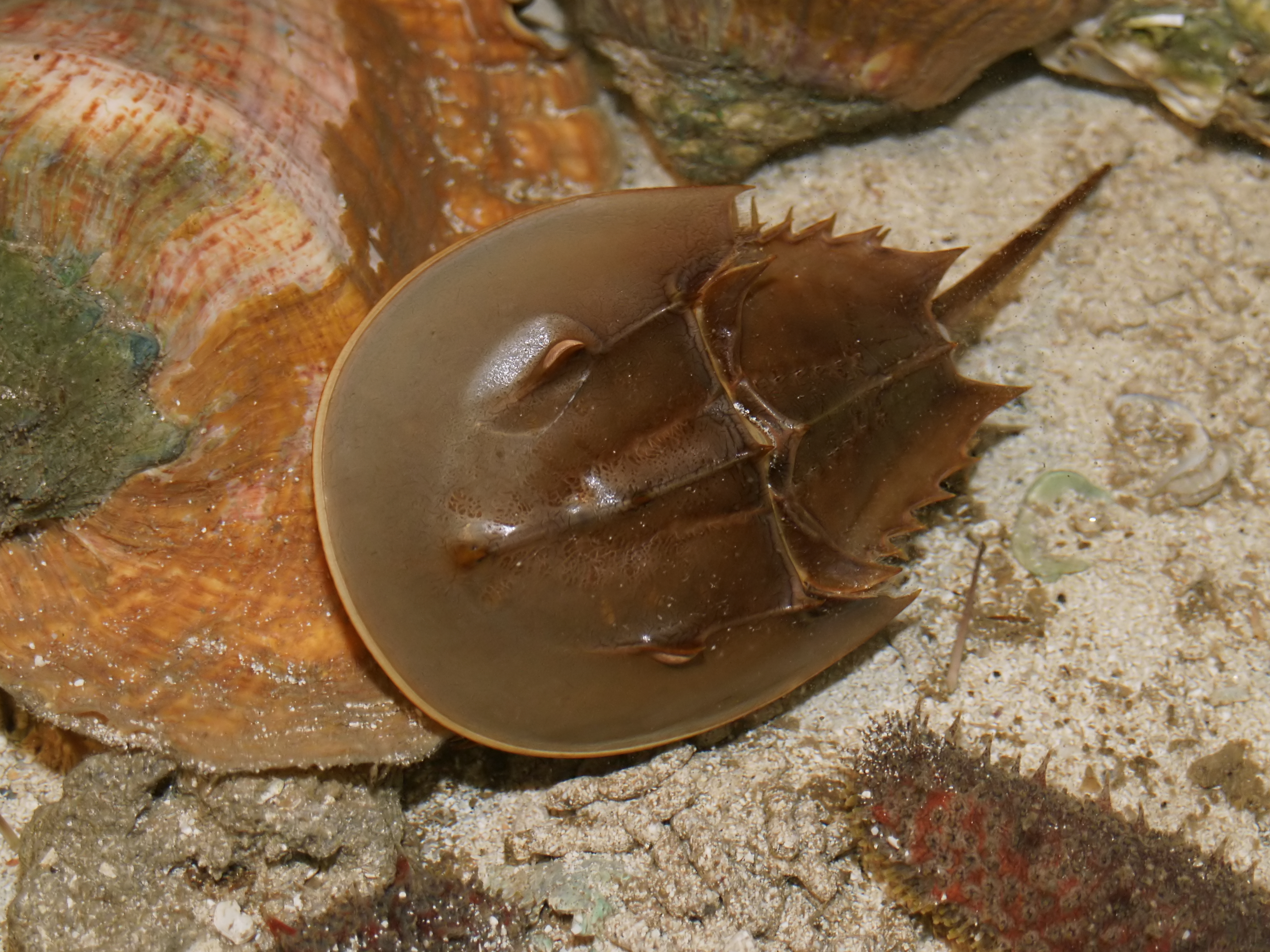
A "living fossil" virtually unchanged for 450 million years. Their copper-based blue blood (LAL) detects bacterial contamination at 1 part per trillion — making it indispensable to vaccine and medical-device safety testing.
§ Quick facts
§ Encyclopedia
The Atlantic horseshoe crab, also known as the American horseshoe crab, is a species of horseshoe crab, a kind of marine and brackish chelicerate arthropod. It is found in the Gulf of Mexico and along the Atlantic coast of North America. The main area of annual migration is Delaware Bay along the South Jersey Delaware Bayshore.
Source: Wikipedia — Atlantic horseshoe crab Licensed under CC BY-SA 4.0
§ Identification
Field marks. Large brown-olive arthropod with hard domed carapace, long stiff tail spike (telson — used to right itself if flipped over, not as a weapon), 10 legs underneath, compound eyes plus simple "evolutionary fossil" eye types.
Similar species. Three other horseshoe crab species (all Indo-Pacific). No other US arthropod is similar.
Voice. N/A
§ Diet & behavior
Diet. Marine worms, mollusks, crustaceans, dead fish — bottom scavenger.
Behavior. Living fossil; lineage essentially unchanged for 445+ million years (predates dinosaurs by 250 million years). NOT actually a crab; closer relative of spiders and scorpions (arachnids). Blue copper-based blood (hemocyanin instead of hemoglobin) is collected in vast quantities for "Limulus amebocyte lysate" — used worldwide to test injectable drugs and medical devices for bacterial endotoxin contamination. Spawning aggregations at Delaware Bay each spring provide critical food for migrating Red Knots and other shorebirds.
§ Range
Atlantic coast from Maine to Yucatan; spawning beaches in Delaware Bay
§ Habitat
Coastal estuaries, sandy beaches (spawning), continental shelf (offshore)
§ Threats
Bait harvest for eel and conch fisheries, biomedical bleeding, climate-driven beach loss, bycatch.
§ Conservation status
According to the IUCN Red List, the atlantic horseshoe crab is currently classified as Vulnerable.
§ What helps
Support synthetic LAL adoption (rFC). Don't purchase horseshoe crab bait. Volunteer for spawning surveys (Delaware Bay).
§ Further reading
- Wikipedia — Atlantic horseshoe crab
- www.fisheries.noaa.gov — authoritative profile of Limulus polyphemus
- IUCN Red List · taxon 11987
- iNaturalist · taxon 49922
- GBIF occurrence records
- Encyclopedia of Life — Limulus polyphemus
§ Sources cited
- Ecological Research and Development Group horseshoe crab
- ASMFC Horseshoe Crab Management Board
- American Museum of Natural History
- IUCN Red List 2016


