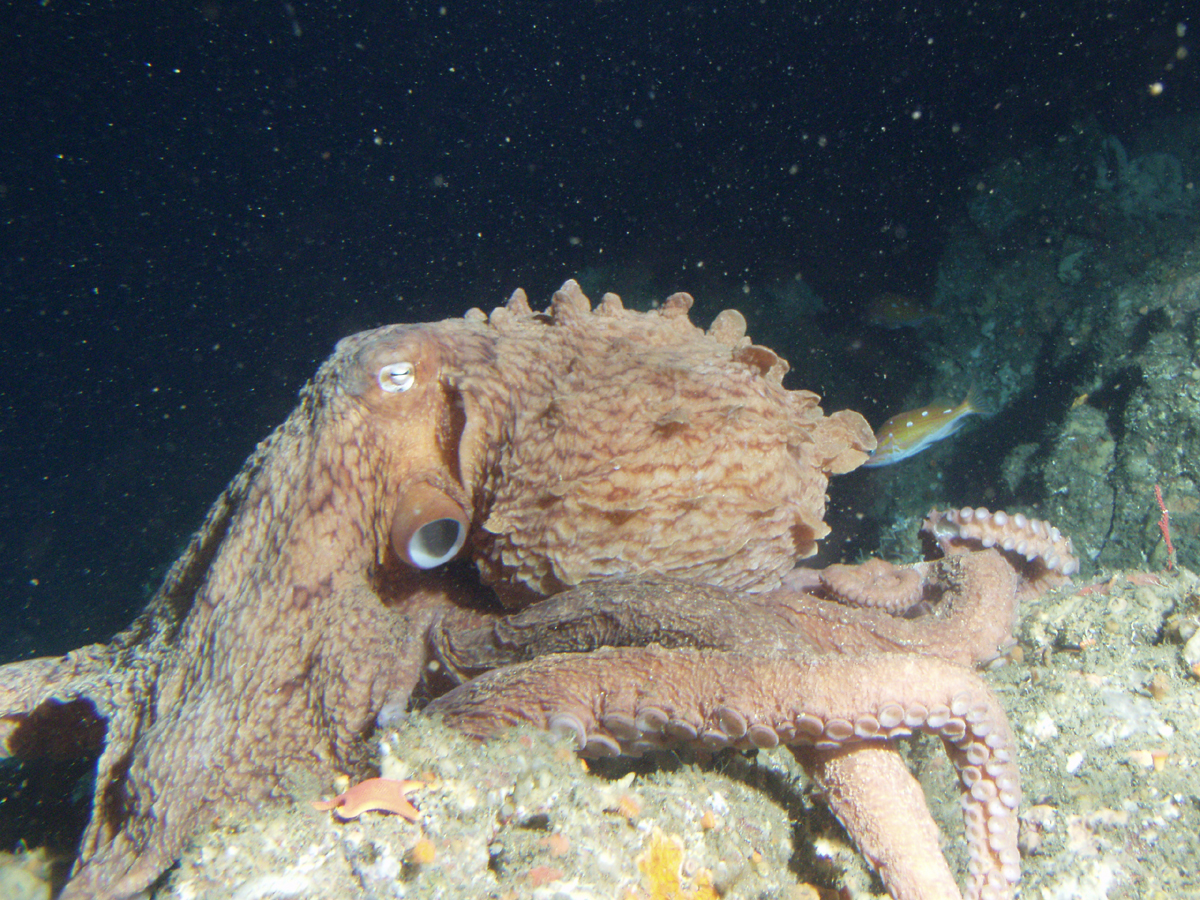
The world's largest octopus species — record arm-spans over 30 feet. Highly intelligent and famously curious; they recognize individual humans, solve puzzle boxes, and have been documented escaping aquarium tanks at night.
§ Quick facts
§ Encyclopedia
The giant Pacific octopus, also known as the North Pacific giant octopus, is a large marine cephalopod belonging to the genus Enteroctopus and Enteroctopodidae family.
Source: Wikipedia — Giant Pacific octopus Licensed under CC BY-SA 4.0
§ Identification
Field marks. Massive red-brown octopus with 8 arms and 280 suckers per arm. Skin texture and color change in seconds via chromatophores. Two parrot-like beaks at center.
Similar species. Smaller Pacific octopus species. East Pacific Red Octopus (much smaller, more uniform color).
Voice. N/A (no sound production).
§ Diet & behavior
Diet. Crabs, clams, shrimp, fish, smaller octopuses, occasionally sharks. Uses arm suckers to capture and immobilize prey, then injects saliva to begin external digestion.
Behavior. Solitary and nocturnal. Among the most intelligent invertebrates — solves puzzles, recognizes individual humans, and engages in play behavior. Female lays 50,000–100,000 eggs in a single brood, guards them for 6–7 months without eating, then dies.
§ Range
Northern Pacific from California to Korea
§ Habitat
Cool coastal waters, rocky bottoms, kelp forests
§ Threats
Climate-driven warming reducing range, accidental capture in commercial fisheries, ocean acidification.
§ Conservation status
According to the IUCN Red List, the giant pacific octopus is currently classified as Least Concern.
§ What helps
Choose sustainably caught seafood. Reduce greenhouse-gas emissions. Support marine protected areas.
§ Further reading
- Wikipedia — Giant Pacific octopus
- www.fisheries.noaa.gov — authoritative profile of Enteroctopus dofleini
- iNaturalist · taxon 114975
- IUCN Red List — search for Enteroctopus dofleini
- GBIF occurrence records
- Encyclopedia of Life — Enteroctopus dofleini
§ Sources cited
- Seattle Aquarium
- NOAA Fisheries
- Cephalopod Research


