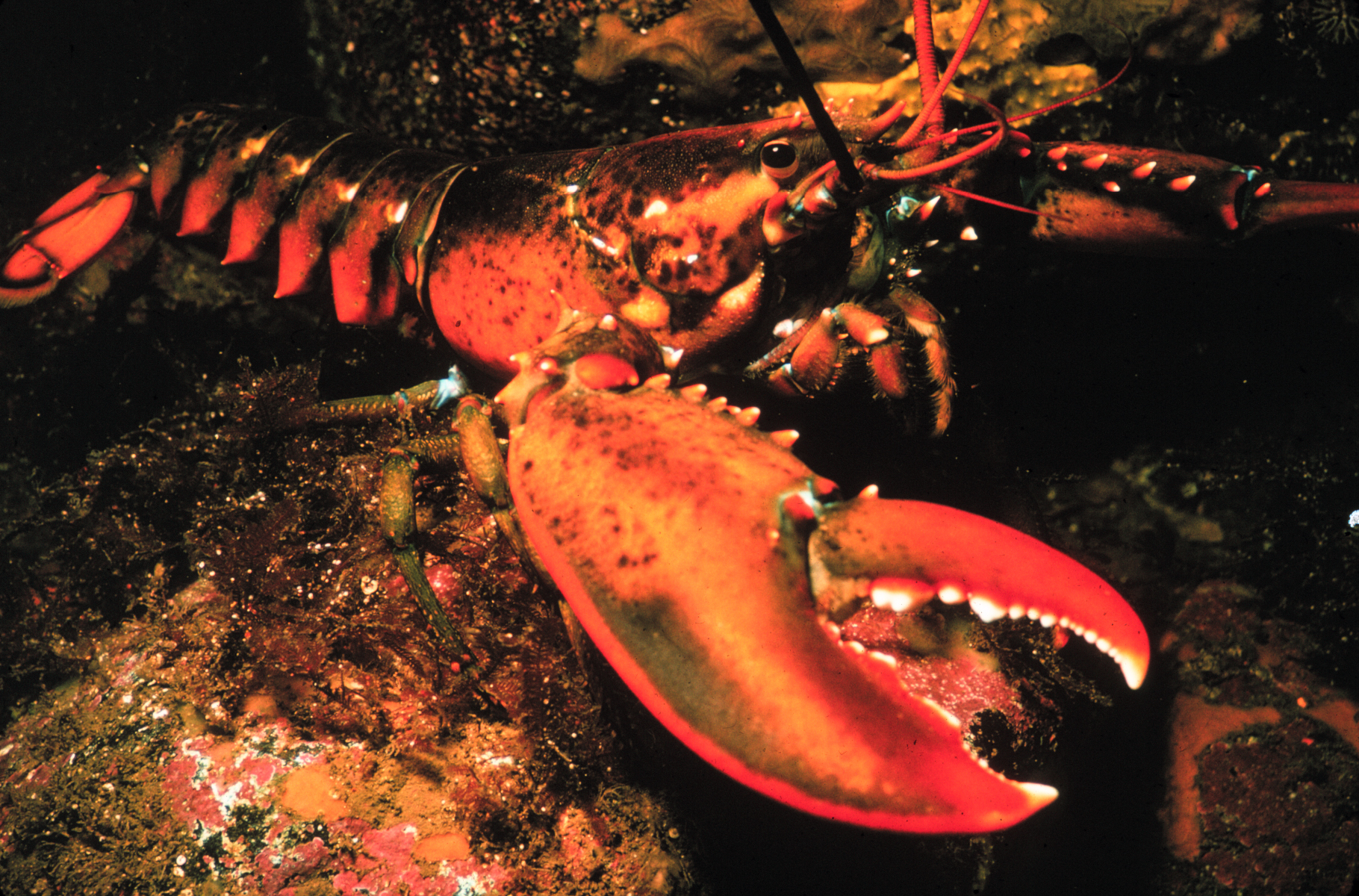
An iconic Atlantic crustacean that can live 50–100 years and weigh up to 44 pounds. Their populations are climate-stressed in southern New England (water too warm) but booming in Maine — for now.
§ Quick facts
§ Encyclopedia
The American lobster is a species of lobster found on the Atlantic coast of North America, chiefly from Labrador to New Jersey. It is also known as Atlantic lobster, Canadian lobster, true lobster, northern lobster, Canadian Reds, or Maine lobster. It can reach a body length of 64 cm (25 in), and a mass of over 20 kilograms (44 lb), making it not only the heaviest crustacean in the world, but also the heaviest of all living arthropod species. Its closest relative is the European lobster Homarus gammarus, which can be distinguished by its coloration and the lack of spines on the underside of the rostrum. American lobsters are usually bluish green to brown with red spines, but several color variations have been observed.
Source: Wikipedia — American lobster Licensed under CC BY-SA 4.0
§ Identification
Field marks. Dark olive-green to brown crustacean with large claws (one larger "crusher" claw, one smaller "pincher" claw — handedness is random). Two pairs of long antennae. Red color appears only after cooking.
Similar species. European Lobster (Old World, no spines on rostrum). Spiny Lobster (no large claws; tropical). Crayfish (much smaller; freshwater).
Voice. Sometimes "stridulates" by rubbing antennae against rostrum.
§ Diet & behavior
Diet. Fish, crabs, mussels, sea urchins, sea stars, other lobsters (cannibalism common).
Behavior. Possibly biologically immortal — lobsters do not show signs of cellular aging and could theoretically live centuries. Death is usually from inability to molt successfully (energy cost of molting becomes prohibitive for very large old individuals). Iconic Maine lobster fishery is one of the most economically valuable US fisheries. Climate change is shifting the species range north; Gulf of Maine waters are warming faster than 99% of the world's oceans.
§ Range
Northwest Atlantic from Newfoundland to North Carolina
§ Habitat
Cold rocky bottoms, coastal waters, estuaries
§ Threats
Climate-driven warming pushing lobsters north, ocean acidification weakening shells, bycatch of right whales in lobster gear.
§ Conservation status
According to the IUCN Red List, the american lobster is currently classified as Least Concern.
§ What helps
Choose Marine Stewardship Council-certified lobster. Support whale-safe fishing gear. Reduce greenhouse-gas emissions.
§ Further reading
- Wikipedia — American lobster
- www.fisheries.noaa.gov — authoritative profile of Homarus americanus
- IUCN Red List · taxon 169672
- iNaturalist · taxon 61214
- GBIF occurrence records
- Encyclopedia of Life — Homarus americanus
§ Sources cited
- Maine Department of Marine Resources
- Gulf of Maine Research Institute
- Lobster Institute University of Maine
- IUCN Red List 2011


