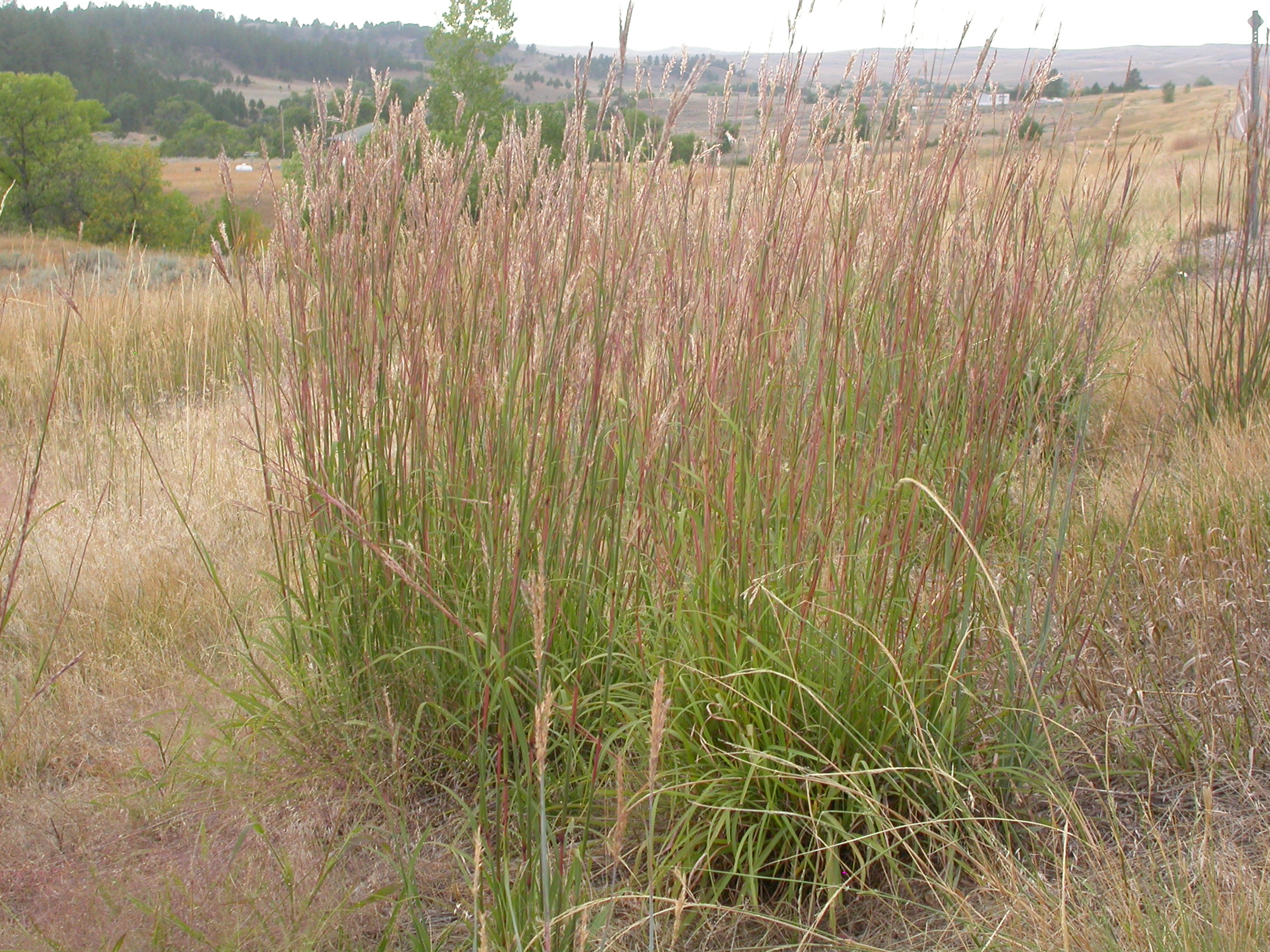
The "monarch of grasses" — the iconic tallgrass prairie grass that once dominated the Great Plains. Reaches 8+ feet tall. Distinctive three-pronged seed heads ("turkeyfoot").
§ Quick facts
§ Encyclopedia
Andropogon gerardi, commonly known as big bluestem, is a species of tall grass native to much of the Great Plains and grassland regions of central and eastern North America. It is also known as tall bluestem, bluejoint, and turkeyfoot.
Source: Wikipedia — Andropogon gerardi Licensed under CC BY-SA 4.0
§ Identification
Field marks. Tall warm-season grass with bluish-green leaves; distinctive three-pronged "turkey-foot" seed head at maturity (looking like a bird's foot); copper-red fall color.
Similar species. Indiangrass (different seed head). Switchgrass (different seed head, more open). Little Bluestem (much shorter, more orange).
Voice. N/A
§ Diet & behavior
Diet. N/A — photosynthesis; C4 metabolism efficient under hot dry conditions
Behavior. Defining grass of the tallgrass prairie — historically dominated 240 million hectares of the central US Great Plains. Roots can comprise 3x the biomass of above-ground tissue, descending 3+ m and creating the prairie's legendary deep, fertile black soil. State grass of Illinois, Missouri, and Oklahoma. Less than 4% of the original tallgrass prairie ecosystem remains.
§ Range
Tallgrass prairie regions
§ Habitat
Tallgrass prairies, restored grasslands
§ Threats
Conversion of tallgrass prairie to row crops, garden monocultures.
§ Conservation status
According to the IUCN Red List, the big bluestem is currently classified as Least Concern.
§ What helps
Plant in prairie gardens. Support prairie restoration. Don't mow during August seed set.
§ Further reading
- Wikipedia — Andropogon gerardi
- www.nwf.org — authoritative profile of Andropogon gerardii
- iNaturalist · taxon 75942
- IUCN Red List — search for Andropogon gerardii
- GBIF occurrence records
- Encyclopedia of Life — Andropogon gerardii
§ Sources cited
- USDA Plants Database
- Konza Prairie LTER
- The Nature Conservancy
- Lady Bird Johnson Wildflower Center


