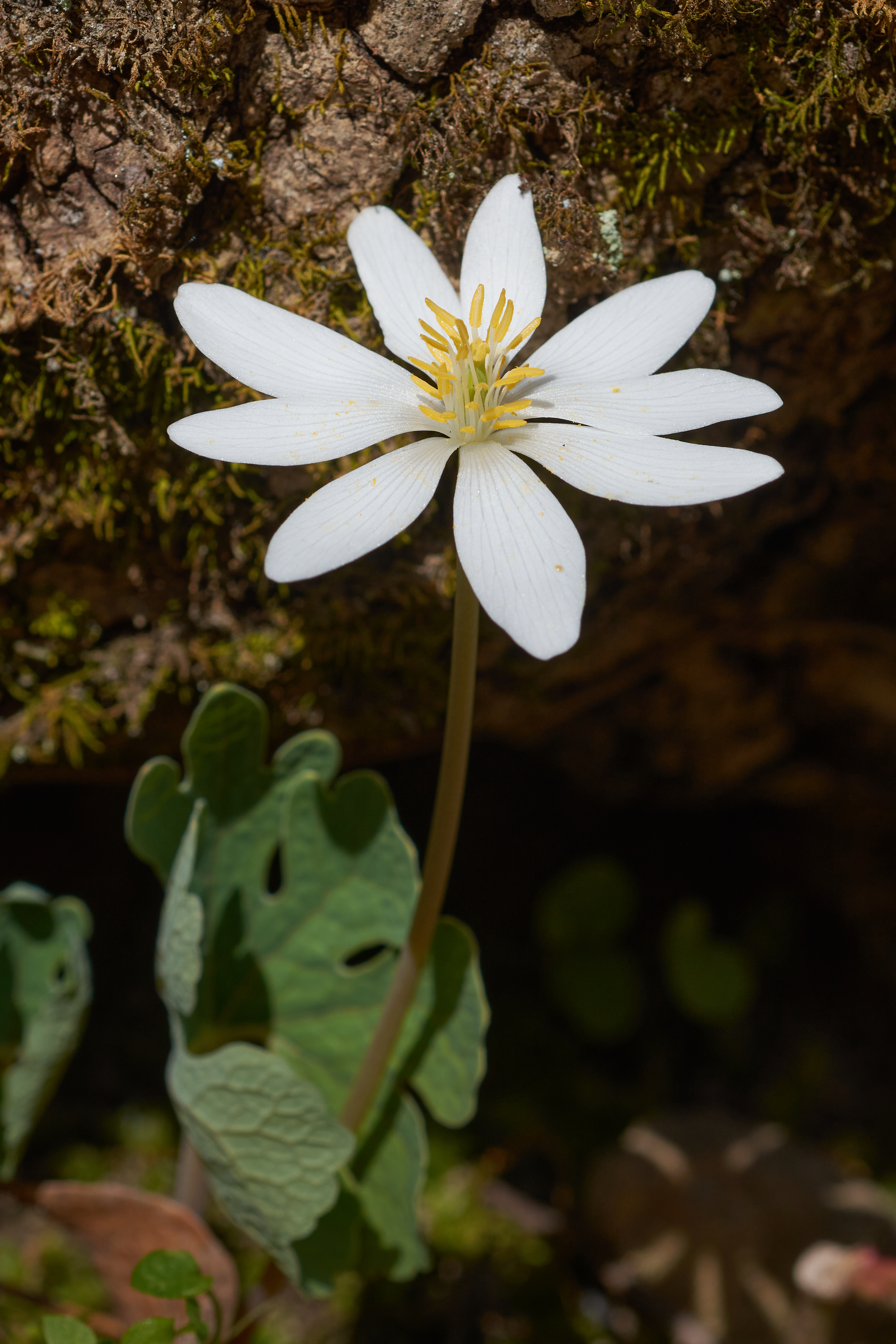
A spring ephemeral with a single round leaf wrapped around a brilliant white 8-petaled flower. Cut roots ooze blood-red sap (giving the name) — used by indigenous peoples as dye.
§ Quick facts
§ Encyclopedia
Sanguinaria canadensis, bloodroot, is a perennial, herbaceous flowering plant native to eastern North America. It is the only species in the genus Sanguinaria, included in the poppy family Papaveraceae, and is most closely related to Eomecon of eastern Asia.
Source: Wikipedia — Sanguinaria Licensed under CC BY-SA 4.0
§ Identification
Field marks. Single deeply-lobed bluish-green leaf wrapped around a single white 8-petaled flower with golden-yellow center; cut roots ooze blood-red sap.
Similar species. Twinleaf (paired leaves). Other spring ephemerals lack the wrapped-leaf pattern and blood-red sap.
Voice. N/A
§ Diet & behavior
Diet. N/A — photosynthesis
Behavior. Spring ephemeral of rich eastern forests. Each plant has one large rounded leaf wrapped around a single flower stem. Flowers open in March–April for only 1–3 days before petals drop — and only when pollinators are active. Seeds bear an elaiosome (fat-rich appendage) that ants collect; ants carry seeds back to nests, eat the elaiosome, and discard the seeds — distributing bloodroot throughout the forest floor (myrmecochory).
§ Range
Eastern North America
§ Habitat
Rich moist deciduous forests
§ Threats
Forest loss, deer overbrowsing, over-collection for herbal-medicine industry.
§ Conservation status
According to the IUCN Red List, the bloodroot is currently classified as Least Concern.
§ What helps
Plant in shade gardens (nursery sources only). Don't over-harvest. Support mature forest protection.
§ Further reading
- Wikipedia — Sanguinaria
- www.nwf.org — authoritative profile of Sanguinaria canadensis
- iNaturalist · taxon 59311
- IUCN Red List — search for Sanguinaria canadensis
- GBIF occurrence records
- Encyclopedia of Life — Sanguinaria canadensis
§ Sources cited
- USDA Plants Database
- United Plant Savers (at-risk medicinal list)
- Lady Bird Johnson Wildflower Center
- New England Wild Flower Society


