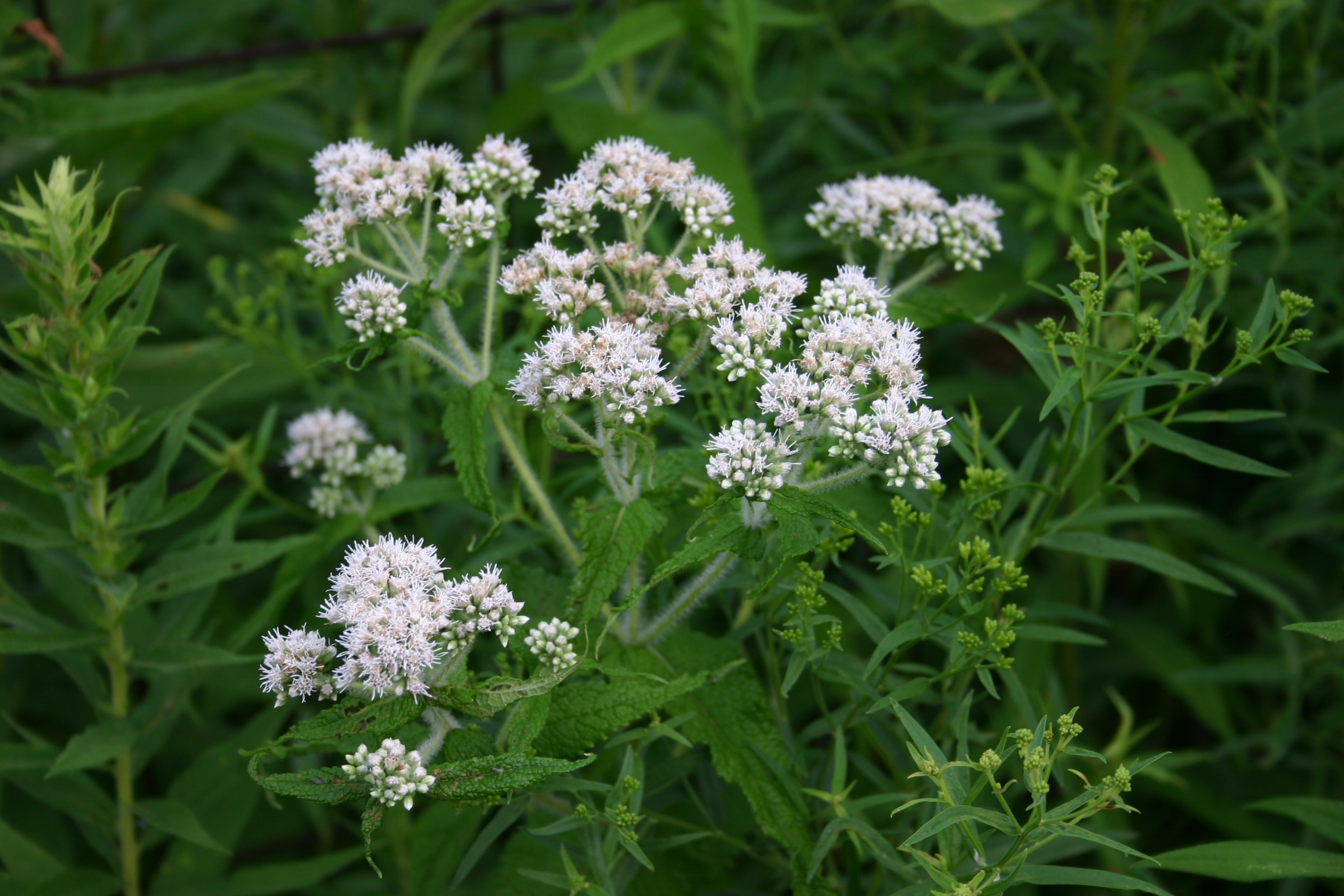
A medium-tall wetland wildflower with opposite leaves that fuse together (perfoliate) and flat-topped clusters of small white flowers. A pollinator powerhouse — late-summer wetland favorite for native bees and skipper butterflies.
§ Quick facts
§ Encyclopedia
Eupatorium perfoliatum, known as common boneset or just boneset, is a North American perennial plant in the family Asteraceae. It is a common native to the Eastern United States and Canada, widespread from Nova Scotia to Florida, west as far as Texas, Nebraska, the Dakotas, and Manitoba. It is also called agueweed, feverwort, or sweating-plant. In herbal medicine, the plant is a diaphoretic, or an agent to cause sweating. It was introduced to American colonists by natives who used the plant for breaking fevers by means of heavy sweating, and commonly used to treat fever by the African-American population of the southern United States. The name "boneset" comes from the use of the plant to treat dengue fever, which is also called "break-bone fever." It is nearly always found in low, wet areas.
Source: Wikipedia — Eupatorium perfoliatum Licensed under CC BY-SA 4.0
§ Identification
Field marks. Tall plant with paired opposite leaves fused around stem; flat-topped clusters of small white flowers.
Similar species. Other Eupatorium species. Joe-Pye Weed (purple flowers).
§ Diet & behavior
Diet. N/A — photosynthesis
Behavior. Native wetland wildflower with flat-topped clusters of small white flowers. Critical late-summer pollinator plant; opposite "perfoliate" leaves where stem appears to pierce through.
§ Range
Eastern North America
§ Habitat
Wet meadows, marshes, riparian areas
§ Threats
Wetland drainage, lawn-centric yards, herbicide use.
§ Conservation status
According to the IUCN Red List, the common boneset is currently classified as Least Concern.
§ What helps
Plant in wet garden corners. Support wetland protection. Skip herbicides.
§ Further reading
- Wikipedia — Eupatorium perfoliatum
- www.nwf.org — authoritative profile of Eupatorium perfoliatum
- iNaturalist · taxon 118870
- IUCN Red List — search for Eupatorium perfoliatum
- GBIF occurrence records
- Encyclopedia of Life — Eupatorium perfoliatum
§ Sources cited
- USDA Plants Database
- Xerces Society


