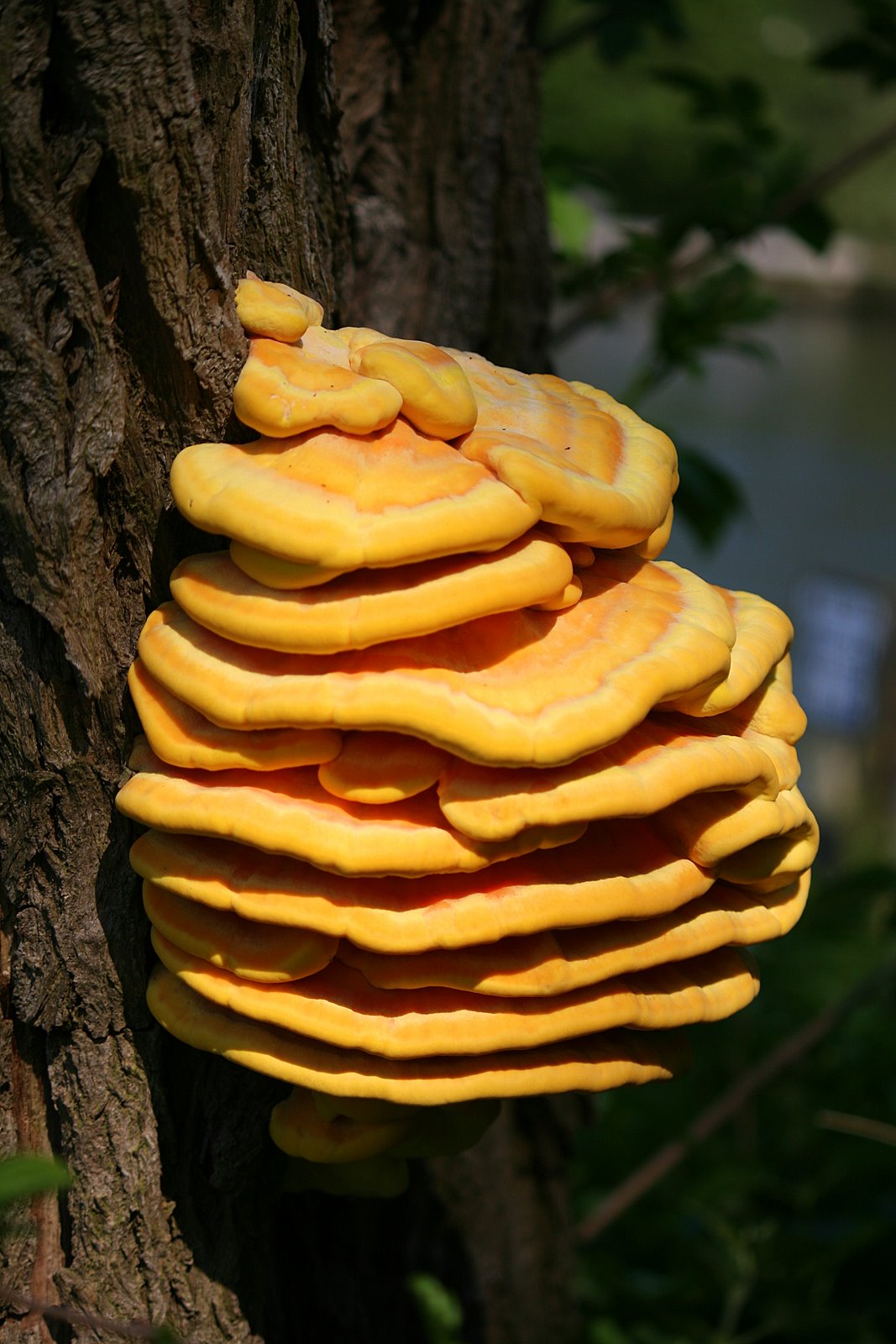
A spectacular bright orange-and-yellow shelf fungus that grows in overlapping fan-shaped clusters on tree wounds. Edible and famously meaty-textured, beloved as a vegetarian "chicken" substitute.
§ Quick facts
§ Encyclopedia
Laetiporus sulphureus is a species of bracket fungus. Its common names include sulphur polypore, sulphur shelf, and chicken-of-the-woods. Its fruit bodies grow as striking golden-yellow shelf-like structures on tree trunks and branches. Old fruitbodies fade to pale beige or pale grey. The undersurface of the fruit body is made up of tubelike pores rather than gills.
Source: Wikipedia — Laetiporus sulphureus Licensed under CC BY-SA 4.0
§ Identification
Field marks. Bright orange-yellow shelf clusters with sulfur-yellow undersides bearing pores (no gills). Cooked, flesh resembles cooked chicken.
Similar species. Bears Head (Hericium americanum; white tooth-like spines). Other polypores typically duller.
Voice. N/A
§ Diet & behavior
Diet. Saprotrophic and weakly parasitic — decomposes heartwood of living and dead hardwoods.
Behavior. Fruits in spring–early summer. Causes brown rot of host trees. Each shelf can produce billions of spores.
§ Range
Eastern North America
§ Habitat
Decaying oak and other hardwood trees; on living wood as a parasite
§ Threats
Mature hardwood forest loss, removal of large old trees with heart rot, climate-driven range shifts.
§ Conservation status
According to the IUCN Red List, the chicken of the woods is currently classified as Least Concern.
§ What helps
Leave decaying logs and snags standing where safe. Support old-growth and mature forest protection.
§ Further reading
- Wikipedia — Laetiporus sulphureus
- www.nwf.org — authoritative profile of Laetiporus sulphureus
- iNaturalist · taxon 118688
- IUCN Red List — search for Laetiporus sulphureus
- GBIF occurrence records
- Encyclopedia of Life — Laetiporus sulphureus
§ Sources cited
- North American Mycological Association
- Mushroom Expert
- iNaturalist