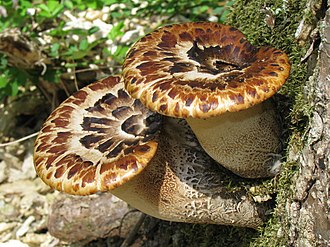
A massive woody perennial shelf fungus that can persist on a single host tree for decades. The pure white spore-bearing underside instantly bruises brown when touched, making it a natural sketching surface — hence "artist's conk."
§ Quick facts
§ Encyclopedia
Ganoderma applanatum is a bracket fungus with a cosmopolitan distribution. As its common names suggest, it can be used as a drawing medium.
Source: Wikipedia — Ganoderma applanatum Licensed under CC BY-SA 4.0
§ Identification
Field marks. Large hard, woody shelf-shaped fungus growing on tree trunks; upper surface concentrically zoned in brown-gray-tan, becoming dust-covered with brown spores over time; pure white pore surface that bruises brown permanently when touched.
Similar species. Other Ganoderma species (different sizes, hosts). Other shelf fungi typically lack the permanently-bruising white pore surface.
Voice. N/A
§ Diet & behavior
Diet. Saprotrophic and weakly parasitic: decomposes heartwood of mature hardwoods (oak, maple, beech, hemlock).
Behavior. Among the longest-lived mushroom fruiting bodies — can persist on a host tree for decades, adding a new growth layer each year. Distinctive feature: the white pore surface darkens permanently when scratched or written on, making the fungus a natural sketching surface used by mountaineers, naturalists, and folk artists for centuries. The trade name "Artist's Conk" reflects this property.
§ Range
Throughout North America
§ Habitat
On dead and dying hardwood trees, especially beech, oak, maple
§ Threats
Loss of mature hardwood forests, removal of dead and dying host trees.
§ Conservation status
According to the IUCN Red List, the artist's conk is currently classified as Least Concern.
§ What helps
Leave dead and dying hardwoods standing where safe. Don't remove fungi from trees. Support old-growth protection.
§ Further reading
- Wikipedia — Ganoderma applanatum
- www.nwf.org — authoritative profile of Ganoderma applanatum
- iNaturalist · taxon 117997
- IUCN Red List — search for Ganoderma applanatum
- GBIF occurrence records
- Encyclopedia of Life — Ganoderma applanatum
§ Sources cited
- Mycological Society of America
- North American Mycological Association
- Cornell Mushroom Blog