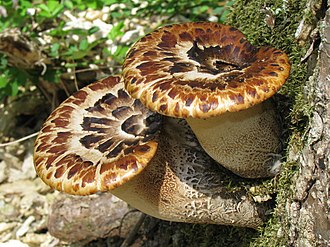
A false morel that looks like a brain-shaped reddish-brown cap. Contains gyromitrin, a precursor to monomethylhydrazine (rocket fuel) — eating it can kill. Mostly avoided but historically eaten in Scandinavia after extensive preparation.
§ Quick facts
§ Encyclopedia
Gyromitra esculenta is an ascomycete fungus from the genus Gyromitra. The fruiting body, or mushroom, is an irregular brain-shaped cap, dark brown in colour, that can reach 10 centimetres high and 15 cm (6 in) wide, perched on a stout white stipe up to 6 cm high. It is widely distributed across Europe and North America, normally fruiting in sandy soils under coniferous trees in spring and early summer.
Source: Wikipedia — Gyromitra esculenta Licensed under CC BY-SA 4.0
§ Identification
Field marks. Wrinkled, brain-like reddish-brown to chestnut cap; cap surface attached to stem at multiple points (not just the base); stem and cap interior chambered, not hollow.
Similar species. True Morels (honeycomb cap, hollow inside, edible). Other false morels (different patterns; all toxic to varying degrees).
Voice. N/A
§ Diet & behavior
Diet. Saprotrophic — decomposes wood and organic matter in conifer and mixed forests.
Behavior. Often confused with edible true morels (Morchella species); contains gyromitrin which metabolizes to monomethylhydrazine (a component of rocket fuel) and can cause severe poisoning, including liver damage and death. Some cultures eat the species after boiling repeatedly (which vents the toxin as steam) — but this practice carries significant risk and is discouraged by mycologists. The wrinkled brain-like cap, attached entirely to the stem, and reddish-brown color help distinguish from true morels (which have honeycomb pits and hollow caps).
§ Range
Coniferous forests across northern North America
§ Habitat
Conifer forests in spring
§ Threats
Habitat loss; some collection by mushroom hunters mistaken for true morels.
§ Conservation status
According to the IUCN Red List, the beefsteak morel is currently classified as Least Concern.
§ What helps
Learn to distinguish from true morels. NEVER eat false morels without expert guidance.
§ Further reading
- Wikipedia — Gyromitra esculenta
- www.nwf.org — authoritative profile of Gyromitra esculenta
- iNaturalist · taxon 118040
- IUCN Red List — search for Gyromitra esculenta
- GBIF occurrence records
- Encyclopedia of Life — Gyromitra esculenta
§ Sources cited
- North American Mycological Association toxicity profile
- American Association of Poison Control Centers
- Mycological Society of America