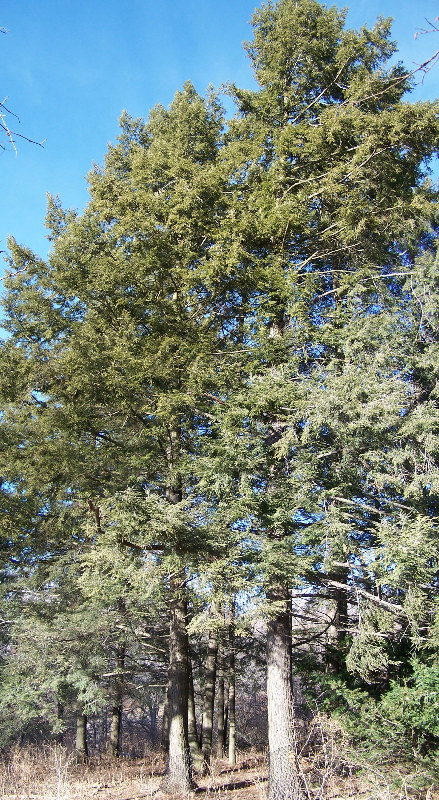
The "redwood of the East" — a long-lived shade-tolerant conifer that creates uniquely cool, deep-shaded forest microclimates that support brook trout and rare salamanders. Currently being decimated by the introduced hemlock woolly adelgid.
§ Quick facts
§ Encyclopedia
Tsuga canadensis, also known as Canadian hemlock, eastern hemlock-spruce, or eastern hemlock, and in the French-speaking regions of Canada as pruche du Canada, is a coniferous tree native to eastern North America. It is the state tree of Pennsylvania. Eastern hemlocks are widespread throughout much of the Great Lakes region, the Appalachian Mountains, The Maritimes and the Northeastern United States. They have been introduced in the United Kingdom and mainland Europe, where they are used as ornamental trees.
Source: Wikipedia — Tsuga canadensis Licensed under CC BY-SA 4.0
§ Identification
Field marks. Pyramidal crown of dense short flat needles; small cones (1–2 cm).
Similar species. Carolina Hemlock. Spruces. Firs.
Voice. N/A
§ Diet & behavior
Diet. N/A — photosynthesis
Behavior. Northeast forest dominant. Critically threatened by hemlock woolly adelgid.
§ Range
Eastern US and Canada from Nova Scotia to northern Alabama
§ Habitat
Cool, moist sites: ravines, north-facing slopes, stream gorges
§ Threats
Hemlock woolly adelgid (Adelges tsugae, introduced from Japan), climate stress, deer browsing on seedlings.
§ Conservation status
According to the IUCN Red List, the eastern hemlock is currently classified as Near Threatened.
§ What helps
Clean boots between forests to avoid spreading adelgid. Support hemlock conservation programs (USFS, TNC). Don't plant Japanese hemlock.
§ Further reading
- Wikipedia — Tsuga canadensis
- www.nwf.org — authoritative profile of Tsuga canadensis
- IUCN Red List · taxon 42431
- iNaturalist · taxon 51955
- GBIF occurrence records
- Encyclopedia of Life — Tsuga canadensis
§ Sources cited
- USDA Forest Service
- The Nature Conservancy
- IUCN Red List 2013


