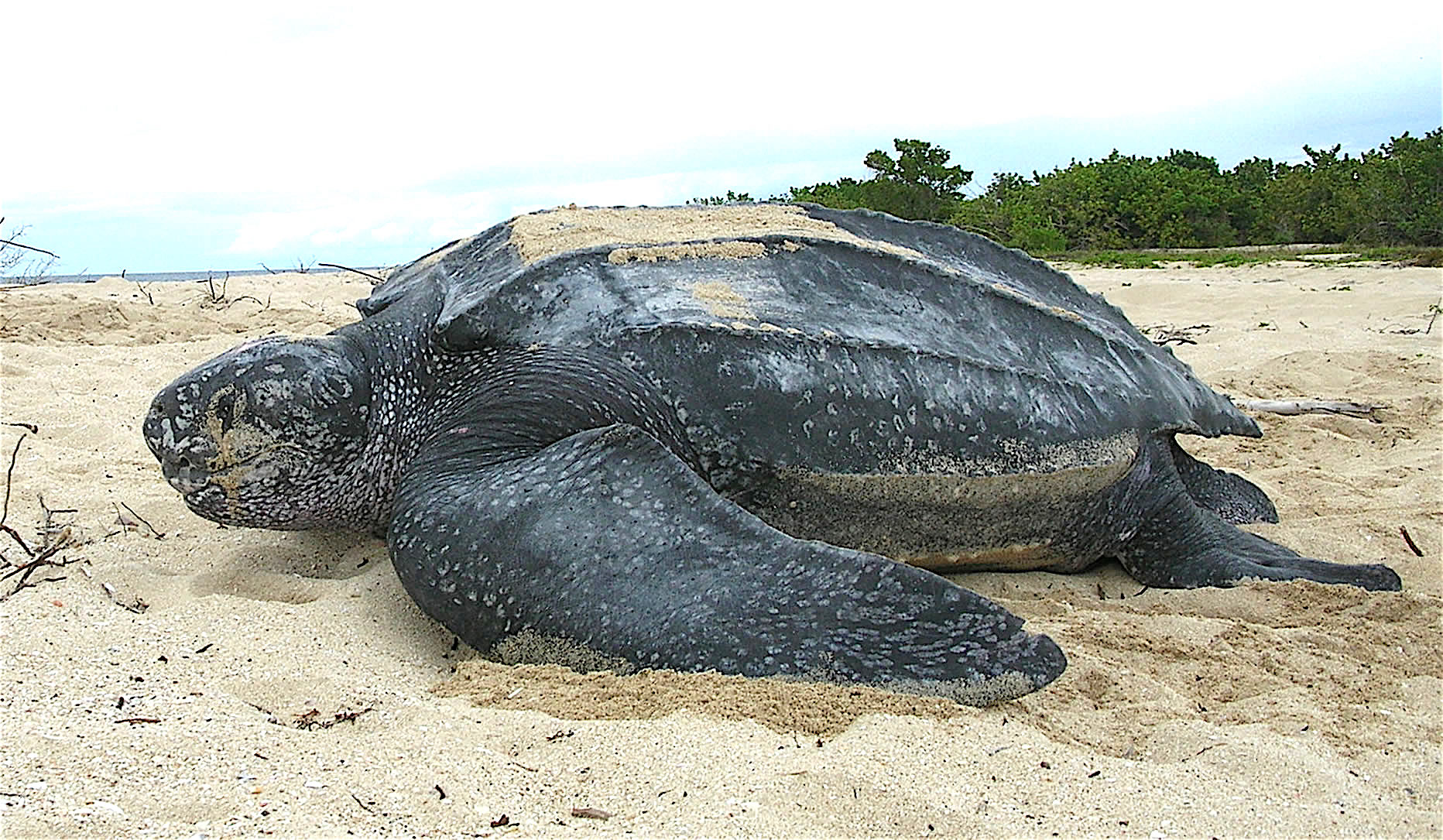
The largest sea turtle in the world — up to 7 feet long and 2,000 pounds. Their leathery shell and unique anatomy let them dive deeper than 4,000 feet and tolerate cold waters no other reptile can.
§ Quick facts
§ Encyclopedia
The leatherback sea turtle, sometimes called the lute turtle, leathery turtle or simply the luth, is the largest of all living turtles and the heaviest non-crocodilian reptile, reaching lengths of up to 2.7 metres and weights of 500 kilograms (1,100 lb). It is the only living species in the genus Dermochelys and family Dermochelyidae. It can easily be differentiated from other modern sea turtles by its lack of a bony shell; instead, its carapace is covered by oily flesh and flexible, leather-like skin, for which it is named. Leatherback turtles have a global range, although there are multiple distinct subpopulations. The species as a whole is considered vulnerable, and some of its subpopulations are critically endangered.
Source: Wikipedia — Leatherback sea turtle Licensed under CC BY-SA 4.0
§ Identification
Field marks. Only sea turtle without a hard shell — leathery skin over a flexible bony framework. Seven longitudinal ridges; dark blue-black with white spotting.
Similar species. Other sea turtles all have hard shells. Loggerhead has massive head; Green Turtle has serrated lower jaw.
Voice. Adults silent. Hatchlings make squeaks and grunts within nest synchronizing emergence.
§ Diet & behavior
Diet. Almost exclusively jellyfish and other gelatinous prey. Backward-facing throat spines prevent prey escape.
Behavior. Diving champion of reptiles — verified dives over 1,250 m (4,100 ft). Migrates 16,000+ km across entire oceans between nesting beaches and feeding grounds.
§ Range
All temperate and tropical oceans; nests primarily in Caribbean and Trinidad
§ Habitat
Open ocean and deep waters; sandy tropical beaches for nesting
§ Threats
Plastic pollution, longline fishery bycatch, illegal egg harvest, beach-light disorientation of hatchlings.
§ Conservation status
According to the IUCN Red List, the leatherback sea turtle is currently classified as Vulnerable.
§ What helps
Skip plastic bags. Choose turtle-safe seafood. Support beach lighting ordinances.
§ Further reading
- Wikipedia — Leatherback sea turtle
- www.fisheries.noaa.gov — authoritative profile of Dermochelys coriacea
- IUCN Red List · taxon 6494
- iNaturalist · taxon 39597
- GBIF occurrence records
- Encyclopedia of Life — Dermochelys coriacea
§ Sources cited
- NOAA Fisheries
- Sea Turtle Conservancy
- The Leatherback Trust
- IUCN Red List 2013


