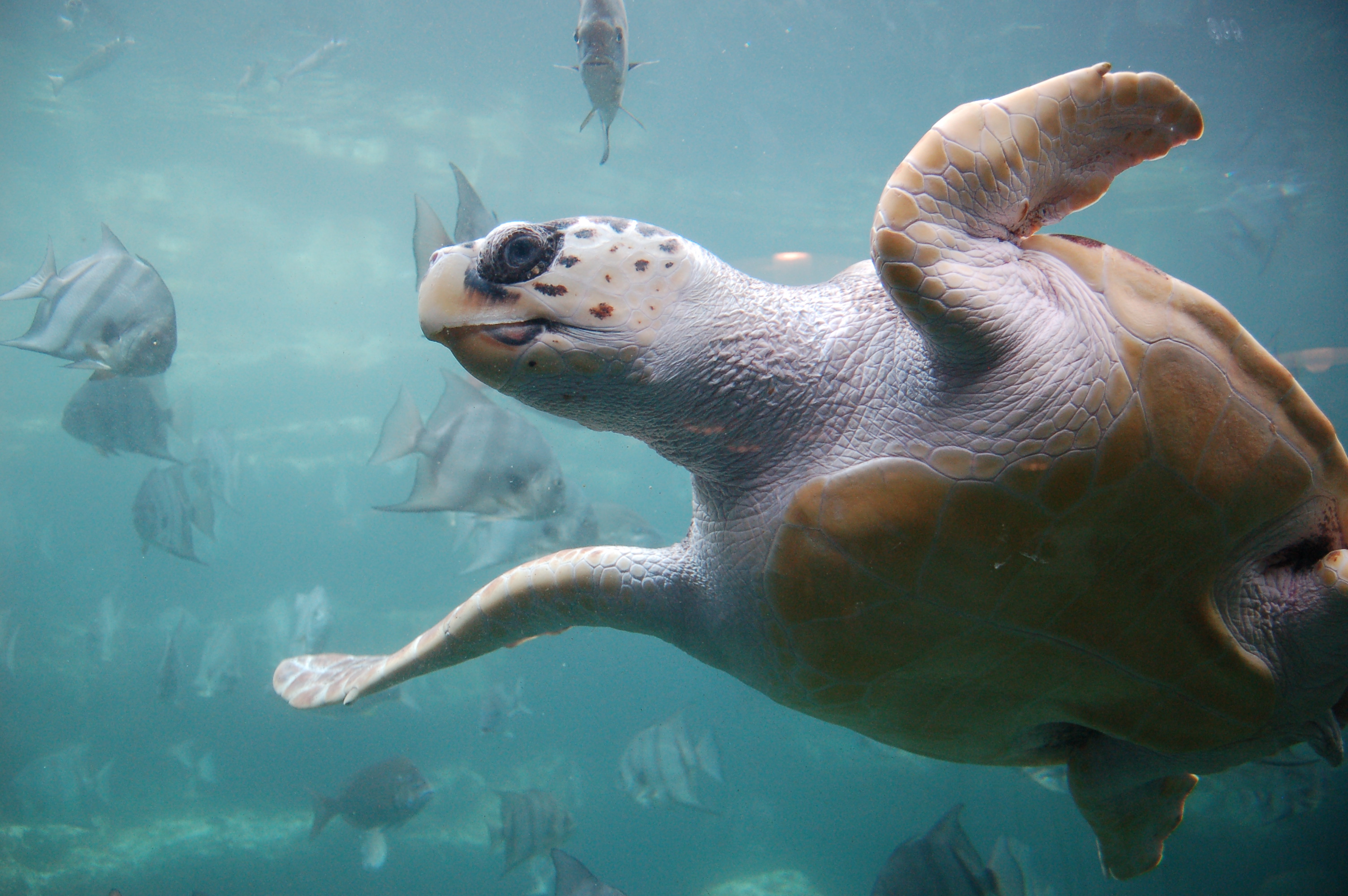
The largest hard-shelled sea turtle in the world, loggerheads return to the same beach where they hatched to lay their own eggs decades later.
§ Quick facts
§ Encyclopedia
The loggerhead sea turtle, loggerhead turtle or loggerhead, is a species of sea turtle distributed throughout the world. It is a marine reptile, belonging to the family Cheloniidae. The average loggerhead measures around 90 cm (35 in) in carapace length when fully grown. The adult loggerhead sea turtle weighs approximately 135 kg (298 lb), with the largest specimens weighing about 200 kg (440 lb). The skin ranges from yellow to brown in color, and the shell is typically reddish brown. No external differences in sex are seen until the turtle becomes an adult, the most obvious difference being the adult males have thicker tails and shorter plastrons than the females.
Source: Wikipedia — Loggerhead sea turtle Licensed under CC BY-SA 4.0
§ Identification
Field marks. Sea turtle with extremely large head and powerful jaws. Reddish-brown shell.
Similar species. Green Sea Turtle (smaller head). Hawksbill (overlapping scales).
Voice. Silent.
§ Diet & behavior
Diet. Crabs, mollusks, squid, sea grasses.
Behavior. Long-distance migrator. Returns to natal beaches to nest. Famous massive head and powerful jaws for cracking shells.
§ Range
Worldwide tropical and subtropical waters; nests on US Atlantic & Gulf beaches
§ Habitat
Open ocean as juveniles; coastal waters as adults; sandy beaches for nesting
§ Threats
Bycatch in fisheries, beach development and lighting disorienting hatchlings, plastic pollution, climate-driven sex ratios.
§ Conservation status
According to the IUCN Red List, the loggerhead sea turtle is currently classified as Vulnerable.
§ What helps
Use turtle-friendly lighting near beaches. Avoid disturbing nests. Support certified sustainable seafood.
§ Further reading
- Wikipedia — Loggerhead sea turtle
- www.fisheries.noaa.gov — authoritative profile of Caretta caretta
- IUCN Red List · taxon 3897
- iNaturalist · taxon 39600
- GBIF occurrence records
- Encyclopedia of Life — Caretta caretta
§ Sources cited
- NOAA Fisheries
- Sea Turtle Conservancy
- USFWS
- IUCN Red List 2017


