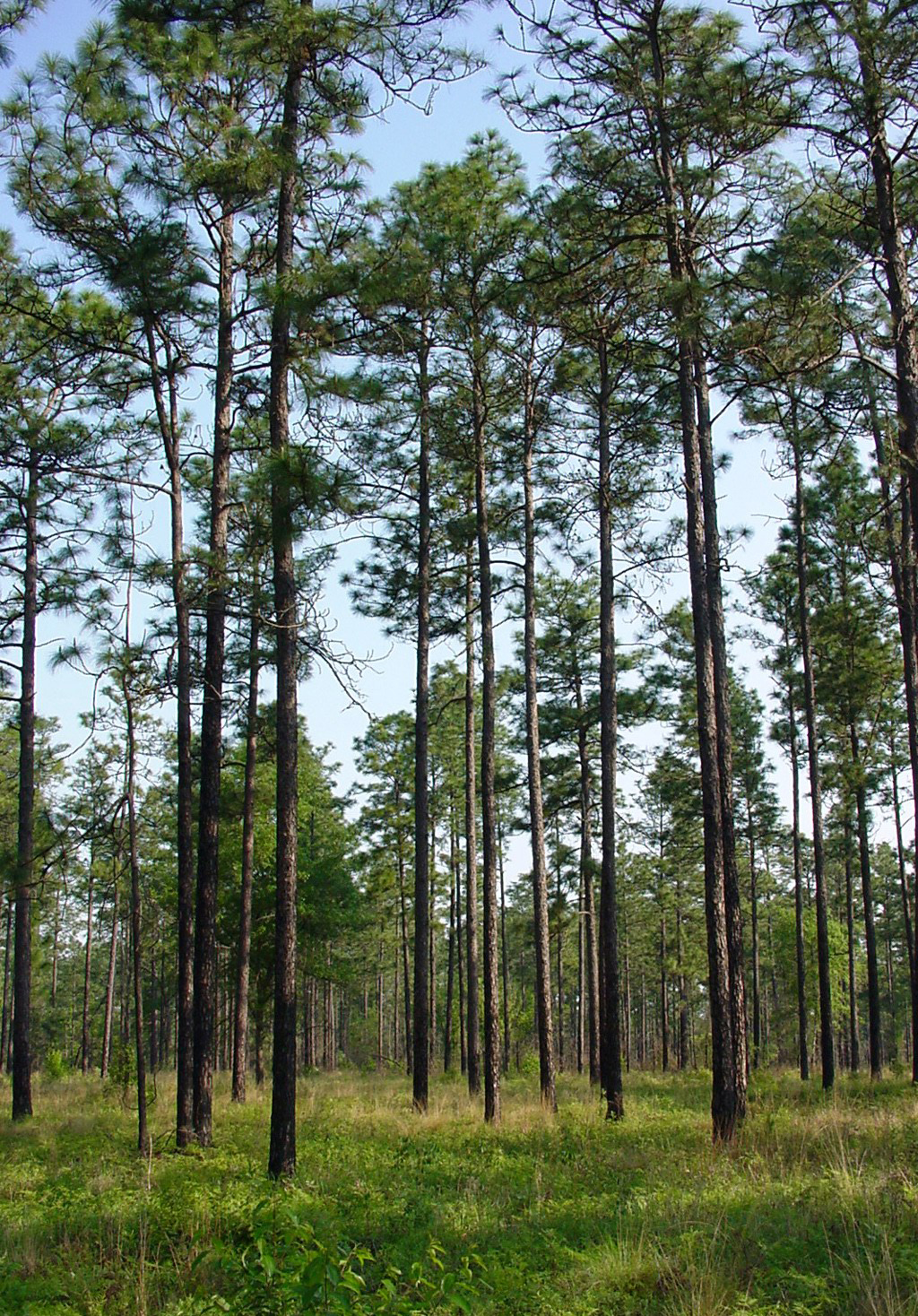
Once dominant across 90 million acres of the Southeast, longleaf pine forests now cover less than 5% of their historic range.
§ Quick facts
§ Encyclopedia
The longleaf pine is a pine species native to the Southeastern United States, found along the coastal plain from East Texas to southern Virginia, extending into northern and central Florida. In this area it is also known as "yellow pine" or "long leaf yellow pine", although it is properly just one out of a number of species termed yellow pine. It reaches a height of 30–35 m (98–115 ft) and a diameter of 0.7 m (28 in). In the past, before extensive logging, they reportedly grew to 47 m (154 ft) with a diameter of 1.2 m (47 in). The tree is a cultural symbol of the Southern United States, being the official state tree of Alabama. This particular species is one of the eight pine tree species that falls under the "Pine" designation as the state tree of North Carolina.
Source: Wikipedia — Longleaf pine Licensed under CC BY-SA 4.0
§ Identification
Field marks. Tall conifer with long needles in bundles of 3 (up to 45 cm).
Similar species. Other southeastern pines.
Voice. N/A
§ Diet & behavior
Diet. N/A — photosynthesis
Behavior. Once dominated 90 million acres of southeast. Slow-growing and fire-tolerant.
§ Range
Southeastern US Coastal Plain from Virginia to East Texas
§ Habitat
Dry sandy uplands maintained by frequent low-intensity fire
§ Threats
Fire suppression, conversion to other pine plantations, urban sprawl.
§ Conservation status
According to the IUCN Red List, the longleaf pine is currently classified as Endangered.
§ What helps
Support longleaf restoration through The Longleaf Alliance. Advocate for prescribed fire.
§ Further reading
- Wikipedia — Longleaf pine
- www.fws.gov — authoritative profile of Pinus palustris
- IUCN Red List · taxon 39068
- iNaturalist · taxon 52106
- GBIF occurrence records
- Encyclopedia of Life — Pinus palustris
§ Sources cited
- Longleaf Alliance
- USDA Forest Service
- IUCN Red List 2013


